
Much of the world around us exists because we collectively agree it does. The money in your wallet, the country you live in, even the laws you follow – these are all real because we, as a society, have agreed they are. These shared ideas form what philosophers call an intersubjective reality.
The glue holding these shared beliefs together? Human language.
In The Nature of Technology, W Brian Arthur defines technology as something that fulfils a human purpose, including human-made systems and assemblies of practices and components within our culture. Using this definition, our intersubjective reality is itself made up of different technologies.
In my blog post Understanding Technology: A Deep Dive, I started to develop an idea that technology sits at the centre of a knowledge and innovation loop, driven by our improved technological tools.
Until now, humans have driven this innovation loop – it’s us who discover new knowledge and turn that knowledge into new or improved technology.
But it raised a question in my mind: “What impact will generative AI have on this innovation loop?” To answer this, I think we need to explore how technology drives innovation in the first place.
The Foundation: Intersubjective Reality as a Human Operating System
Intersubjective reality emerges from our ability to share ideas and reach collective agreement. But what makes this sharing possible in the first place?
Language. At first, verbal communication allowed us to coordinate and create shared meaning. Then came written language, and everything changed.
Written language has distinct advantages over the spoken word. It allows us to communicate across vast distances and, crucially, through time. I’m currently re-reading The Lord of the Rings by JRR Tolkien, someone I never met and who died in 1973.
Consider this blog post itself. I’m sitting at my desk in Cornwall, England, writing this sentence on 3 January 2026. You’re reading it somewhere else entirely, at some point in the future.
Look at a five-pound note issued by the Bank of England. It states: “I promise to pay the bearer the sum of five pounds.” That simple promise, backed by collective trust, underpins pound sterling as a major global currency.
This is all based on technology. Reading and writing themselves form an intersubjective reality – those of us who read and write English have reached agreement on what words mean and how they’re spelt, even if regional differences exist.
The mechanism of writing depends entirely on technology – be it pen and paper or, in this case, the sharing of digital data between computers.
Without writing, we wouldn’t have formed our great civilisations or their underlying legal and financial systems. And we wouldn’t be able to write without the technology enabling it – whether that’s a clay tablet and stylus or the digital technology powering this blog.
Technology can take existing communication forms and transform them entirely. The printing press made the distribution of new ideas dramatically easier, fundamentally altering our shared reality. More recently, the internet has accelerated this transformation exponentially.
The AI Revolution: A New Mirror to Humanity
We don’t yet know if generative Artificial Intelligence, such as Large Language Models, will lead to Artificial General Intelligence (AGI) – AI that matches or exceeds human intelligence.
Even if it doesn’t, the technology will likely impact how we collectively see the world. Until now, only humans could shape our shared beliefs. But as Yuval Noah Harari put it: “We have given AI the keys to our operating system.”
This is happening right now. In my blog post Philosophy Place on CTNET: Why Now?, I wrote:
“Even now, in the early days of large language models, we are consuming content written by large language models. I wrote this paragraph after feedback on my final draft, and it suggested that I should add more on how large language models could impact the cocoon of intersubjective reality. Its response has influenced my action. One paragraph on its own will have no impact, but how many would?”
There’s research suggesting that AI use narrows the diversity of generated content. It makes me wonder: is AI averaging out our collective output? If so, is that in itself evidence of AI acting as a mirror on humanity?
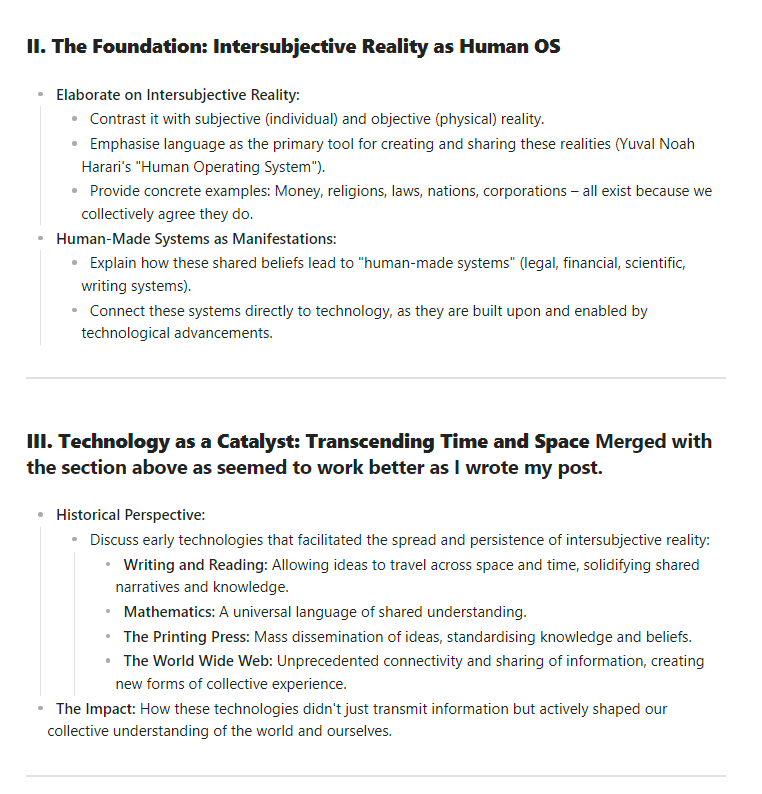
That’s why I insist on writing the first draft of any blog post myself, based on notes I’ve already created. AI can suggest a possible layout to help me get started, but my posts often evolve organically as I write. In this very post, two of my planned sections merged into one during the writing process.
It’s not just AI narrowing our experiences. Recommendation algorithms – most famously on social media, where they drive doom scrolling – shape what we see and consume. You’ll encounter them on streaming services too. In my recent Spotify review, I called their music recommendation system a double-edged sword: brilliant at recommending music I’ll love, but at the risk of narrowing my tastes to fewer and fewer artists.
There’s nothing inherently wrong with this technology – we just need to remain aware and maintain control. Most importantly, we need to identify what matters most to us and protect those areas, perhaps even establishing red lines. For me, that’s my first-draft writing. Otherwise, we risk losing our cognitive independence and abilities.
Navigating the Future: A Symbiotic Relationship
As Stuart Russell writes in Human Compatible:
“Technology enabled us to rise up on a pyramid of machines and tools.”
Humans are technologists. It seems to me that we’ve developed a symbiotic relationship with our technology, and this partnership allowed us to evolve beyond being hunters and gatherers. We became farmers, built our earliest civilisations, and eventually became writers and sharers of information and knowledge.
Technology amplified our ability to share knowledge across space and time, which in turn accelerated innovation and the development of even more sophisticated technology.
Generative Artificial Intelligence represents another way for us to share knowledge. But it also has the potential to fundamentally alter our symbiotic relationship with technology.
You might be asking yourself why.
Well, generative AI self-generates content. It may be based on material it consumed during training, but it nonetheless builds responses on the fly, predicting what seems appropriate in the moment.
Until the last few years, any content you consumed was written and edited by a human being. That’s now changing. You have to wonder what impact this will have on our intersubjective future.
That’s why all of us need to consider how we’ll use these powerful tools. I’ve established three red lines:
- I write my literature notes in my PKM (Personal Knowledge Management) system
- I write my own permanent notes in my PKM system
- I write the first draft of every post
These red lines ensure that I make the best use of writing as a thinking tool. The friction of transforming fuzzy thoughts into written content – like this blog post – is where real understanding emerges.
Secondly, as a society, we need to think carefully about these impacts. That’s why I’d love to read your thoughts in the comments below.
Finding Our Way Forward
We’ve journeyed from the foundations of our shared reality through to the transformative potential of AI. Technology has always shaped how we create and share meaning – from the earliest written symbols to the printing press to the internet. Each advancement has accelerated the spread of ideas whilst simultaneously changing how we think.
Now we face perhaps the most profound shift yet. Generative AI doesn’t just transmit our ideas – it generates its own responses, potentially reshaping the very fabric of our collective beliefs.
This isn’t a moment for panic, but it is a moment for thoughtfulness. We need to understand these tools, establish our own boundaries, and remain conscious participants in shaping our shared future. My three red lines are just my starting point – what will yours be?
The symbiotic relationship between humans and technology has brought us extraordinary benefits. Let’s make sure our next chapter maintains what makes us human: our ability to think independently, create uniquely, and consciously choose the beliefs we share.
What are your thoughts on AI’s impact on our shared reality? How are you navigating these changes? I’d genuinely love to hear your perspective in the comments below.
Want to stay updated with my latest thoughts on PKM, AI, and knowledge management? Subscribe to my newsletter for regular updates.
Further Reading
Books Referenced:
- Yuval Noah Harari, Homo Deus – Explores humanity’s future and the role of technology
- W Brian Arthur, The Nature of Technology – Foundational thinking on how technology evolves
- Stuart Russell, Human Compatible – On AI and humanity’s future
Related CTNET Posts:
- Understanding Technology: A Deep Dive – My exploration of technology’s role in knowledge and innovation
- Navigating the Future: Insights from Yuval Noah Harari on AI and Humanity
- Philosophy Place on CTNET: Why Now?
- Spotify Review 2025 – On recommendation algorithms as a double-edged sword
- CTNET Guide to Managing Literature Notes
- Beginners Guide to Permanent Notes
External Reading:
- Claire Mason: “Dumbing Down or Wising Up: How Will Generative AI Change the Way We Think?” – Research on AI’s cognitive impacts