
Since the invention of writing, people have raised concerns about how technology impacts our cognitive ability.
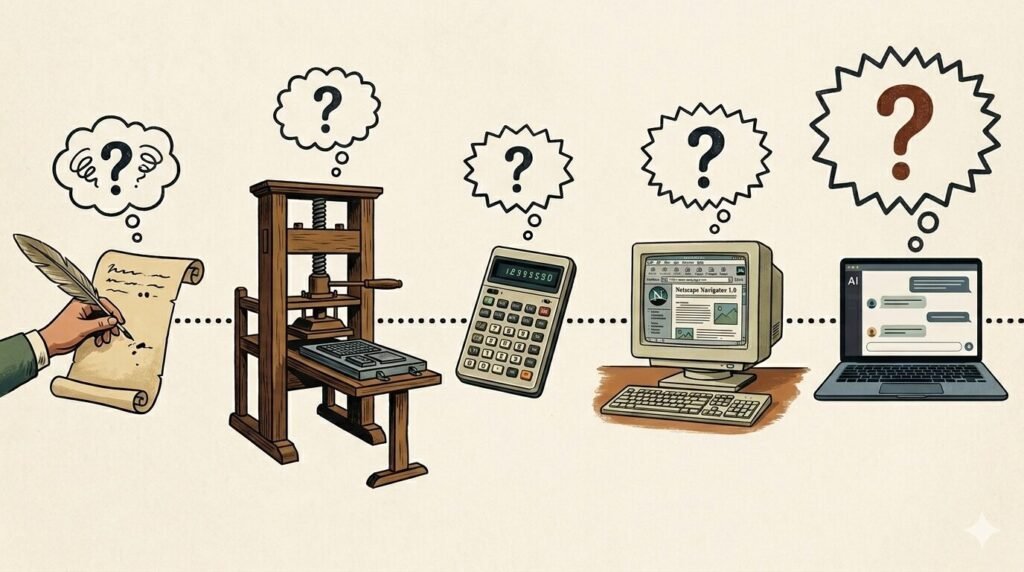
Though the technology in the crosshairs has changed throughout history, examples include the printing press, the calculator when I was growing up, then the web, and now the increasing use of Large Language Models.
But generative AI (Gen AI) could be different — all the other forms of technology reproduced human knowledge. Generative AI can generate its own content, and that is something new.
A brief history of cognitive fear
Throughout history, certain technologies have raised concerns related to the loss of human cognition. These technologies include:
- Writing
- Printing press
- Calculator
- Internet
- Generative Artificial Intelligence (Gen AI)
If you look back to being a child, we pick up spoken language with ease. Yet reading is a lot more difficult, and some children like myself face real difficulty. That is because writing is a technology we invented, yet it has impacted our intellectual evolution.
Socrates himself is believed to have had concerns that writing could have a negative impact on our memory. But is writing a note in fact a memory aid, such as writing a shopping list so you don’t forget the milk?
The invention of the printing press led to concerns around information overload, and it is something I would like to investigate further, as the Internet a few hundred years later has led to the same concerns around information overload.
I myself have written content about how to manage information overload, and central to my approach is my PKM and the Zettelkasten method. You have to wonder if the commonplace book was an attempt to manage the information overload from the printing press. It would be an interesting idea to explore.
The Internet
Claude, when it laid out this piece, gave this section the title “The Internet – Our Best Evidence” but I haven’t gone for it as the layout was generated from my notes and as a technology blogger I have more notes on the research carried out on the Internet.
But then again, the research for the Internet could be better, as scientific research would have been carried out during the evolution of the Internet, and it’s an evolution I don’t think has yet finished.
There is around 30 years of different studies on how the Internet has impacted how we think.
- Our knowledge about knowledge has increased. We have a better understanding of how to find information using web-based tools such as search engines. Unsurprisingly, this is also known as the Google effect.
- Improved problem solving
- Improved creative thinking due to the reduction of needing to remember stuff due to search engines.
- Reduced ability to focus
- Increased dependency on technology.
- Increased cognitive self-esteem. We think we have become cleverer.
- Reduced critical thinking due to accepting what we are told without questioning it.
While the Internet appears to have some positive impacts as well as negative ones, such as the Google effect, which shows that we are more likely to forget facts as we know we can easily retrieve them again by searching the web.
The pattern
As I mentioned earlier in this post, humans were not born to read, and the act of reading can change our brains. It raises the question: what impact will generative AI have on us?
The previous section on the Internet has shown that it’s not just books that have had an impact on our cognitive ability. So it seems natural to ask what impact generative AI will have on the human mind, so that we have a chance to manage these impacts.
That is the core consideration for this post and the series as a whole.
Why is AI different to previous technologies?
I think the biggest difference is that AI in the form of generative AI, such as Large Language Models, is able to create things in response to a human prompt — and potentially other AIs, for example through the use of AI agents.
Until recently, every book you read was written by a human, and when you read it, we got the insights of another human being. The invention of the printing press and the Web improved distribution, but the words were still those of the original author.
That is no longer the case — AI can write its own content, and as the models improve, it will be more difficult to tell the difference.
Amir Husain, in his book The Sentient Machine, put forward an idea that AI, at a certain point in its development before we reach Artificial General Intelligence — which is basically AI as intelligent as a human being at a range of tasks — would act as a mirror on humanity.
For me, AI reached that point during the spring of 2025. During this window, however long it lasts, we have an opportunity to explore our most fundamental questions, such as:
- What is uniquely human?
- What do we want to become in the age of AGI?
- Do all of our complex goals come from our biological needs?
After all, AI is crafted on assumptions about how human thought works.
The use of Large Language Models (LLMs) has given us the opportunity to learn the human psychological vulnerability to Artificial Intelligence. This vulnerability is our natural tendency to anthropomorphise technology, increasing our entanglement with it.
And a Large Language Model appears to be more human due to its ability to talk to us, and that is one of its biggest risks.
Conclusion
In this post, we considered the impact on us individually. In our next post in this series, we consider how these issues could impact our wider society, exploring the possibility of a Knowledge Collapse: The Hidden Risk of the AI Age.
Further Reading
- Hao-Ping (Hank) Lee, Microsoft Research, The Impact of Generative AI on Critical Thinking Self-Reported Reductions in Cognitive Effort and Confidence Effects From a Survey of Knowledge Workers
- Understanding Information Overload
- Claire Mason, Dumbing Down or Wising Up How Will Generative AI Change the Way We Think
- Aaron French, Assistant Professor of Information Systems, Kennesaw State University, Is ChatGPT Making Us Stupid
- Shai Tubali, The Mechanized Mind AI’s Hidden Impact on Human Thought
- Margaret Pan, Why You Should Read “Difficult” Books
- Key Takeaways of Stuart Armstrong, Smarter Than Us
- Amir Husain, The Sentient Machine
- The Sentient Machine: Key Takeaways on AI, Humanity, and Our Future
- Introductory Guide to Artificial General Intelligence
- Nir Eisikovits, AI Isn’t Close to Becoming Sentient – The Real Danger Lies in How Easily We Anthropomorphize It