
In 2025, I came back to Spotify due to the promise of lossless music. Was it enough for me to return permanently?
What is Spotify?
Spotify is the biggest music and audio streaming service in the world, having moved beyond music streaming to include podcasts and audiobooks.
This review is based on my experiences of streaming music, as I’m not a fan of audiobooks and I use Snipd for listening to podcasts due to its note-taking capabilities.
2025: The Year of Lossless Music
Spotify has been promising lossless music for years, and in 2025, they finally delivered. That was the main reason for me coming back.
So what exactly is lossless music?
Digital compression can be split into two distinct types: lossy and lossless. Lossy compression creates smaller files but at the expense of losing data which isn’t considered essential, while in lossless compression, no data is lost.
Spotify used to stream music using either AAC or Ogg Vorbis formats, which are both lossy formats. In September 2025, Spotify started rolling out lossless music streams using the FLAC format.
Spotify lossless music is at least 16-bit sampled at 44.1 kHz, which is the same quality as a music CD, and currently supports up to 24-bit at 44.1 kHz. Many of its competitors, such as Tidal, go up to 24-bit 192 kHz.
The question is: can you hear the difference? I think you can, but how you listen to your music will have an impact. Ideally, you’ll be listening to music using wired headphones.
Most Bluetooth devices will use compression to enable the music data to be sent.
If you stream music on the go, you might want to use one of the lower-quality streams to keep your usage within any data allowances.
Does the Lower Sampling Rate Than Tidal Make a Difference?
The simple answer is yes, especially if you’re listening to music on decent equipment, but it isn’t as big a difference as between lossy and lossless.
Most of the music on Tidal has a sample rate no higher than 48 kHz.
Personally, I’ve found that I can live with this limitation, and I’m hopeful that Spotify will at some point look to rectify this.
Music Discovery
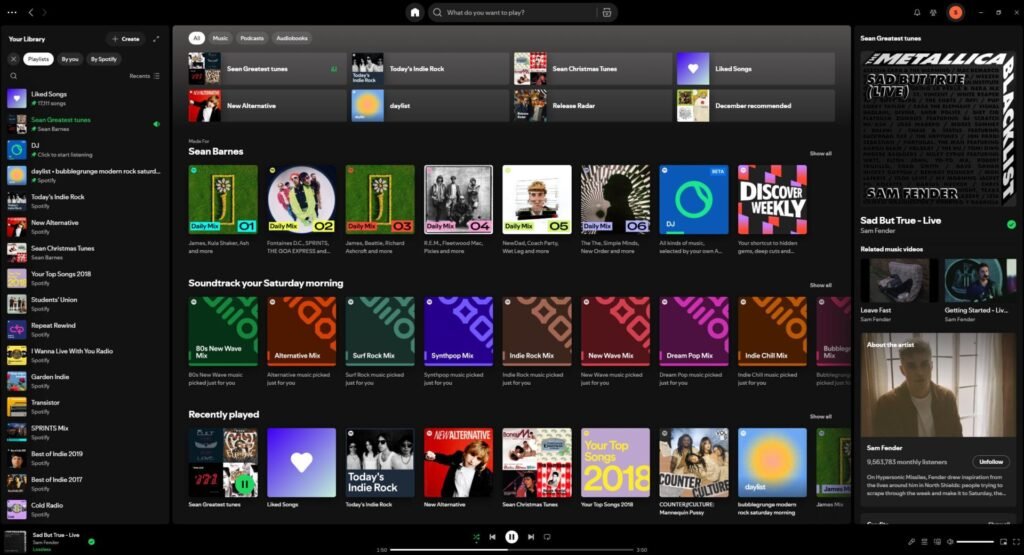
Music discovery in Spotify can be excellent, with the likes of Release Radar and Discover Weekly, as well as genre-related playlists aimed at promoting new releases. It is certainly better than Tidal for this.
However, I’ve found over recent weeks that this is a double-edged sword, as the algorithms that help drive Release Radar and Discover Weekly can also trap you into listening to the same music over and over again.
To a certain point, this is a good thing, as it can keep exposing you to new tracks again and again, helping you to realise how much you like them. But beyond a specific point, it could trap you into listening to a very tight selection of specific tracks by specific artists.
I’m still working on how I’m going to manage this issue with Spotify, but a good place for me to start will be a blog post I wrote on finding new music on Tidal.
AI DJ
I love the concept of the Spotify AI DJ, and I do listen to music using it at times—normally when I don’t want to spend too much time thinking about playlists, or occasionally just for a change.
However, it has a couple of flaws. Firstly, I find the number of tracks between DJ interactions too long, as I see it as almost being your own virtual radio station. I would like sections to be two or three tracks before moving onto its next selection, with the intro between selections detailing something interesting about the artist or your listening habits.
I’ve also noticed that it repeats the same tracks over and over again, and this impacts how often I use this functionality. It has shown me a need to shake up the algorithm.
Conclusion
Overall, Spotify is the best music streaming service out there now that it has finally introduced lossless-quality music streams. It is still the best platform I have used for musical discovery.
However, you do need to bear in mind that those same algorithms can limit your listening if you just stick to the Spotify AI-generated playlists.
Further Reading
- How I find new music on Tidal: A blog post detailing my strategy for discovering new music on Tidal in 2024, which will be the starting point for figuring out how to do the same on Spotify.