
As a blogger, I’ve learnt the importance of working with the creative process rather than fighting against my mental state.
But creativity isn’t just important for artists or writers—it’s vital for all of us. Creativity is what allows us to solve problems, whether we’re designing a blog post, tackling a work challenge, or navigating daily life.
Understanding how creativity works can help you harness it more effectively. Let’s explore the four stages of the creative process and how you can work with them, not against them.
The Four Stages of Creativity
Stage 1: Preparation
The preparation stage is the laying of foundations for our creativity. It’s the gathering of information, both through intentional research and general exploration of things that intrigue you. It also includes defining the problem or project you’re trying to resolve.
For me, this stage includes consuming content, processing my notes in my Zettelkasten, and my recent explorations with Artificial Intelligence—which often lead to content ideas such as this blog post.
The preparation stage also encompasses capturing the initial idea and managing this post through my blog creation process.
Consider this: What things spark your interest and curiosity? Why don’t you follow them and see where they take you?
Stage 2: Incubation
The incubation stage is the unconscious phase. It highlights the importance of rest, which so many of us underestimate. This is when you give your unconscious mind an opportunity to work on your problems and projects.
I find that ideas can bubble up during the night when I wake or first thing in the morning. I noticed the same pattern when I took my dog George out for his walks. It can also happen when you’re working on another unrelated task. Which takes us to the third stage.
Consider this: Where are you when your ideas come to you?
Stage 3: Illumination (The Aha Moment)
This is when you get that sudden flash of inspiration or insight. It often happens during the incubation stage or while working on an unrelated task. The important thing is to capture the idea before it fades away.
I capture my ideas in several ways: on a piece of paper, in my Obsidian daily journal, or wherever is convenient in the moment. It doesn’t really matter how you capture it. What’s important is that you capture it, and that at some point in the future you verify it.
Consider this: How will you capture your insights when they strike?
Stage 4: Verification
The verification stage is when you evaluate the ideas and insights that appeared during the illumination stage to create a tangible outcome.
For a writer like myself, it’s the writing and editing of the content I create. As I lay out, write, and even edit a blog post, I’m testing my ideas. There have been times when I’ve stopped writing a blog post because the idea wasn’t ready at that point.
Even when an idea fails verification, it helps with future preparation.
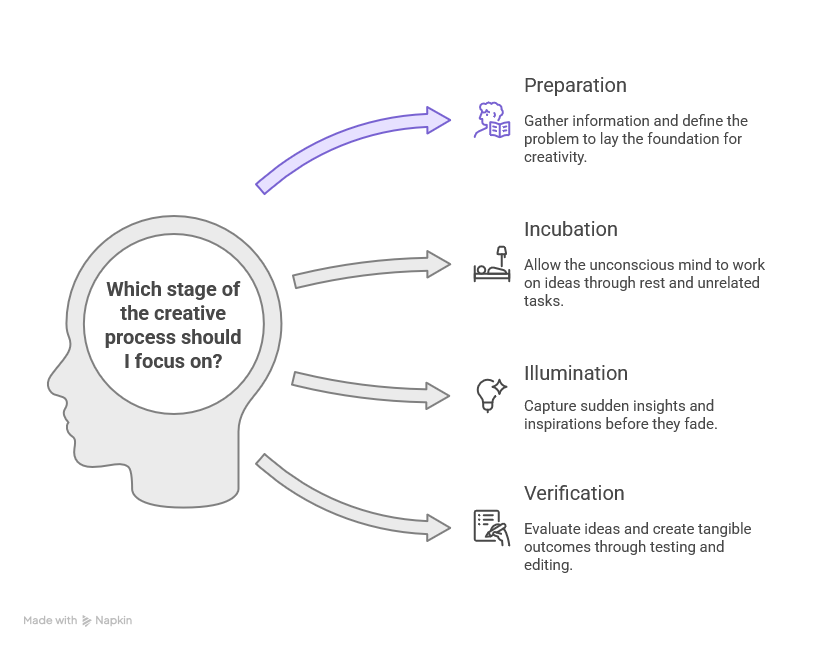
Creativity Is Non-Linear
The way I’ve structured this post might give the impression that creativity is a systematic process, with one phase leading neatly to another. But that isn’t how creativity works.
Creativity is non-linear. At any point in the process, you can have an illumination.
It can happen when I’m working on my notes or planning my writing schedule. It can happen when I’m at rest or doing unrelated work. It quite often happens when I’m writing or editing a blog post.
This flexibility allows you to work on multiple projects at the same time. Whilst writing this blog post, I have another one to edit, others being laid out, ideas for future possible posts, and I’ve carried out research and followed my curiosity.
Conclusion
In this post, we’ve explored the four stages of creativity and discussed how the process is non-linear.
What’s important is that you spend time on each stage and give yourself the space to think, along with a means to capture your ideas and insights.
Why don’t you start paying attention to these stages in your own creative work? You might be surprised at what you discover about your own process.
Further Reading
- Unleashing Creativity: A Deep Dive into “Mind Management, Not Time Management” by David Kadavy
- Mind Management Not Time Management by David Kadavy