
This is part four of our series exploring why technology is outpacing society. In this post we will explore why our minds are also struggling to keep up.
As a 55-year-old man living in England, I can remember a time before home computers when information was relatively sparse, unlike now, when the Internet puts information at our fingertips.
I hadn’t really experienced information overload until I was 51: the dread that I was going to miss something important, be it an article that could help me write my next blog post, as I drowned in links of articles I thought would be worth reading. This is information overload, and it is the curse of living in an information golden age.
The Hardware Problem
It comes down to a problem with our biological hardware: all of us can hold seven items in our working memory, within a two-item range, individually. That was true when neuro surgeon Karl Pribram and psychologist George Miller during the 1960’s and it is now.
Working memory plays a similar role to RAM (Random Access Memory) in computers, in that both can only work on the things which are in working memory.
Add to this that a high cognitive load can have a negative impact on our willpower.
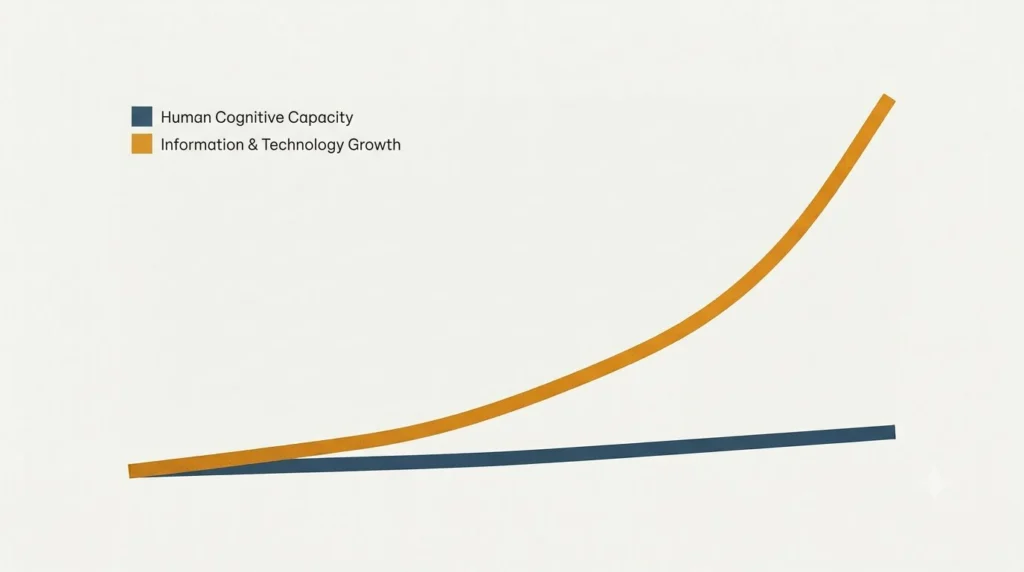
While the amount of information flowing around us has exponentially increased from my youth to today, my ability to process it hasn’t. There are ways to manage this, but it is outside the scope of this blog post. But I will link to my post on why PKM is essential in 2025, which is a good starting point.
What 30 Years of Internet Research Shows
I used the Internet for the first time in 1996 as a mature student at my local college, and had access at home by the start of the 21st century, which means that we have 30 or more years of research and data on how the Internet has impacted our cognitive abilities.
These 30 years of research have shown:
- Our knowledge on knowledge has increased. We have a better understanding of how to find information using web-based tools such as search engines. Unsurprisingly, this is also known as the Google effect.
- Improved problem solving.
- Improved creative thinking due to a reduced need to remember things, thanks to search engines.
- Reduced ability to focus.
- Increased dependency on technology.
- Increased cognitive self-esteem. We think we have become cleverer.
- Reduced critical thinking due to accepting what we are told without questioning it.
What AI Is Specifically Doing
If the Internet has had such an impact on our mind, you have to wonder what impact the emergence of Large Language AI models such as ChatGPT, Claude or Gemini will have on us going forward.
A 2021 report by the US National Commission on Artificial Intelligence found that the increasing use of AI was ‘mind altering’.
The report found that the human mind is being altered in the following ways.
- Reduces inquisitiveness
- Making us more trustworthy of technology
- Reduces our ability to find our own purpose
The economics of the exponential gap, which we covered in the last post, requires a social solution, while the cognitive gap we’ve covered in this post requires us to act as individuals. In the next post we will explore our options.
Further Reading
- What is information overload: My introductory guide to Information overload
- Gary Keller, The One Thing: Contains an interesting section on managing willpower
- Claire Mason, Dumbing Down or Wising Up How Will Generative AI Change the Way We Think: The original source on how the Internet has impacted our cognitive abilities
- Gary Grossman, AI Algorithms Could Disrupt Our Ability to Think: Article considering the cognitive impact of AI
- Reid Hoffman with GPT-4, Impromptu: Amplifying Our Humanity Through AI: Book on how to use AI models specifically GPT-4
- Brian W. Stone, Associate Professor of Cognitive Psychology, Boise State University, How Does AI Affect How We Learn A Cognitive Psychologist Explains Why You Learn When the Work Is Hard: Source material for part of the section on what AI is doing specifically