I have been using a Personal Knowledge Management (PKM) System in the form of my Zettelkasten for almost five years. It has become my workspace for thinking. I now see it as a core component in protecting my cognitive abilities.
But I also see the potential of it being more than just a shield to protect my cognitive abilities, but also as a means of doing so if AI is used correctly.
Zettelkasten can improve your metacognition as it can help you to determine your own strengths and weaknesses, supported by the fact that your permanent notes are written in your own words. This will help you to identify the gaps in your knowledge.
What is a Personal Knowledge Management (PKM) System
A PKM isn’t about storing information. It is a personal architecture aimed at helping you to think and remember. It also acts as a support for growing your cognitive and metacognitive abilities.
A PKM becomes a reflection of its owner. I have been keeping my PKM for nearly five years and I think it is an accurate reflection of my interests over that time.
A PKM system’s primary objective is to help you embed the knowledge of others by absorbing their ideas and thoughts into your own. It also acts as an external memory device and a space to explore your own thinking. It isn’t there to increase your productivity.
You don’t use a PKM to help your understanding of the world, but to strengthen your ability to think for yourself. That is why I think having a PKM can help you protect your cognitive abilities from AI.
Examples of PKM systems include Zettelkasten and digital gardens. I personally have a Zettelkasten, so that is the PKM method we will be exploring in the rest of this blog.
The Zettelkasten as a Thinking Integrated Environment
A Zettelkasten is a framework which allows you to take fleeting notes as you come to them through life, from an idea that comes to you while walking the dog, to a paragraph you have read which really resonates with you, through literature notes to the permanent notes that live in your Zettelkasten.
Your Zettelkasten is a place to capture ideas in the form of notes. These ideas can be either your own or the ideas of others captured in your own words from the content you consume.
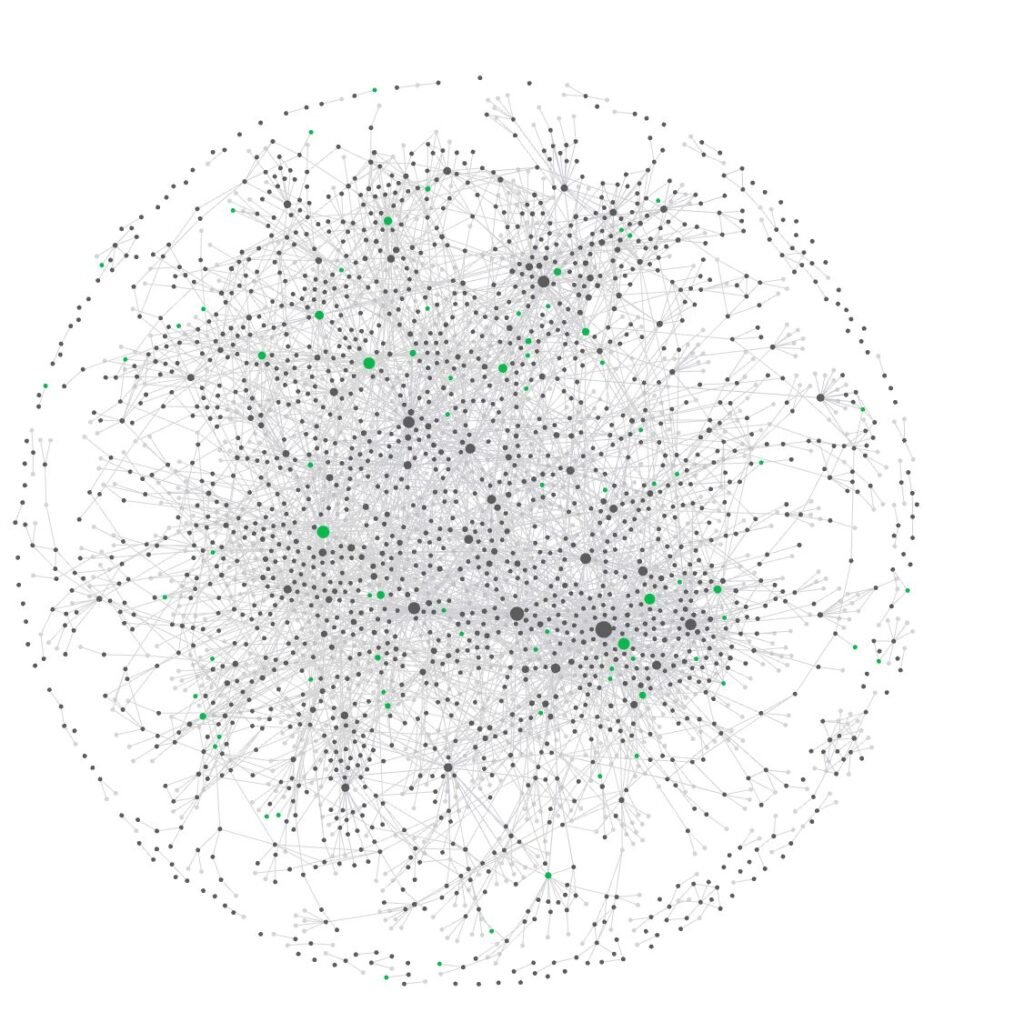
The Zettelkasten encourages the creation of knowledge by the linking of related ideas, thoughts and concepts contained within your permanent notes, creating a web of knowledge.
A Zettelkasten offers an external scaffold built on your permanent notes and the links between them, creating a framework which allows you to develop your ideas.
As Niklas Luhmann said, ‘It is a combination of disorder and order’, and it is this combination which gives us the synergy to think.
A PKM reflects its owner like AI reflects Humanity
Amir Husain argued in his book The Sentient Machine that an AI can act as a mirror on humanity before the emergence of AI. This is at least in part due to the fact that AI is trained on huge quantities of human knowledge.
A PKM meanwhile contains notes on all the things that you are interested in and therefore acts as a reflection of your interests.
Your PKM would also be a good source of context regarding your interests, which would be helpful to a personal AI assistant.
The benefits of Zettelkasten for learning
Learning is the process of gaining new skills and knowledge by mastering the foundation of that subject. This underlying knowledge will be enriched further by experience in that area.
The Zettelkasten method has a lot in common with the Feynman technique as the permanent notes which sit at the heart of your Zettelkasten have to be written in your own words. These permanent notes are never considered complete, allowing them to be refined and simplified over time.
Take my note on learning. It has been refined at least twice as I have two sections in my notes based on content I have consumed from two different sources, reflecting how my thoughts on learning have changed over time.
The Ebbinghaus forgetting curve was pioneered by Hermann Ebbinghaus, a curve that tracks the loss of knowledge after the learning of something new. Within a day we lose somewhere between 50% and 80%. By day 7, we can only remember 10% of it. By day 30, we might remember 2% to 3% of what we had learnt.
However, this loss of new knowledge can be reversed by revising it through spaced intervals. And while the Zettelkasten method isn’t a real spaced interval technique, it does encourage you to consider existing notes that you might have forgotten, or ones you have only a slight recognition of.
When I create a new permanent note, I have to consider if I have any other related notes which I should link to and this can lead me to revisiting a note I had previously written.
A good example of this in practice is how the concept of Intersubjective reality has developed over time. I first came across the idea when reading Homo Deus by Yuval Noah Harari.
From the highlights I took from the book, a permanent note was created in my own words. Some time later, I started to connect other ideas to that idea and eventually it became ingrained knowledge as it was obviously a key concept for the ideas I had been consuming.
An Intersubjective reality is a reality created by our society due to us all agreeing that it is true, such as money and our legal system. It’s our underlying culture.
The future: AI and PKM together
This series of blog posts likely came about due to me seeing both the potential and the risk of pairing my underlying Zettelkasten with Large Language Models.
I was worried as the biggest thing I have learnt from my Zettelkasten is that some friction is needed. It is the friction of writing my own literature notes and permanent notes that helps me learn. It was that friction that enabled me to absorb the idea of intersubjective reality into my own thinking.
It has encouraged me to carry out my own research as I look to make best use of the ever-expanding capabilities of AI, whilst discovering what is most important to me.
It has led to the creation of my AI and PKM framework developed by myself with inputs from both Gemini and Claude. It is a living framework which will change over time with experiences and knowledge.
At the centre of this framework are the three core red lines.
- I write my own literature notes
- I write my own permanent notes
- I create my own links between permanent notes. AI can recommend them but only I can create the link.
Series conclusion
In this series we have explored the potential risks of AI on our cognitive abilities and the impact that it could have on us as both individuals and the wider society.
We looked at those concerns in a wider historical context, as these concerns have been voiced before about other technologies such as writing and the internet, before considering what makes this time different.
We considered the AI cognitive ability paradox that sits at the heart of our concerns. The last two posts are really an attempt to limit the negative impact of this paradox and ensure we keep and even build on our cognitive abilities using these tools.
You can sign up for our monthly newsletter to be kept updated on our latest content.
Further reading
- Steven Thompson, Reflecting on My PKM System
- Tiago Forte, Building a second brain
- Introduction to the Zettelkasten system
- Sonke Ahrens, How to take smart notes
- unibo.it, Niklas Luhmann’s Card Index The Fabrication of Serendipity
- Luca Vettor, The Note Strategist, Learning Strategy for Everybody
- Beginners guide to permanent notes
- Farnam Street, The Feynman Technique The Best Way to Learn Anything
- Scott Mautz, Train Your Brain to Remember Anything You Learn With This Simple, 20-Minute Habit
- Yuval Noah Harari, Homo Deus