Back in 2020, when the pandemic was at its height, I began blogging. I started compiling a list of web articles to spark ideas for future posts and broaden my knowledge of technology. It didn’t take long for me to feel overwhelmed.
That was my first real experience of information overload: too much information, not knowing where to begin, and the fear of missing out (FOMO).
I remember feeling stressed, which prevented me from reading as many articles as I would have liked.
Around 2021, things began to change when I discovered the Zettelkasten method and Personal Knowledge Management (PKM). Over the past four years, using my Zettelkasten has enabled me to manage large quantities of information
My system isn’t perfect, and it still creaks at times, but I feel more in control of the content I consume.
What is a PKM system?
Before exploring how a PKM (Personal Knowledge Management system) can help you tame the ‘information beast’ of information overload, we should define what a PKM is.
A PKM system provides a framework for capturing information and transforming it into knowledge. Examples of PKMs include Zettelkasten and Digital Gardens.
At the heart of my PKM sits a Zettelkasten comprised of a few thousand permanent notes. Each note is atomic, focusing on a single idea. These notes are linked to other related notes via backlinks.
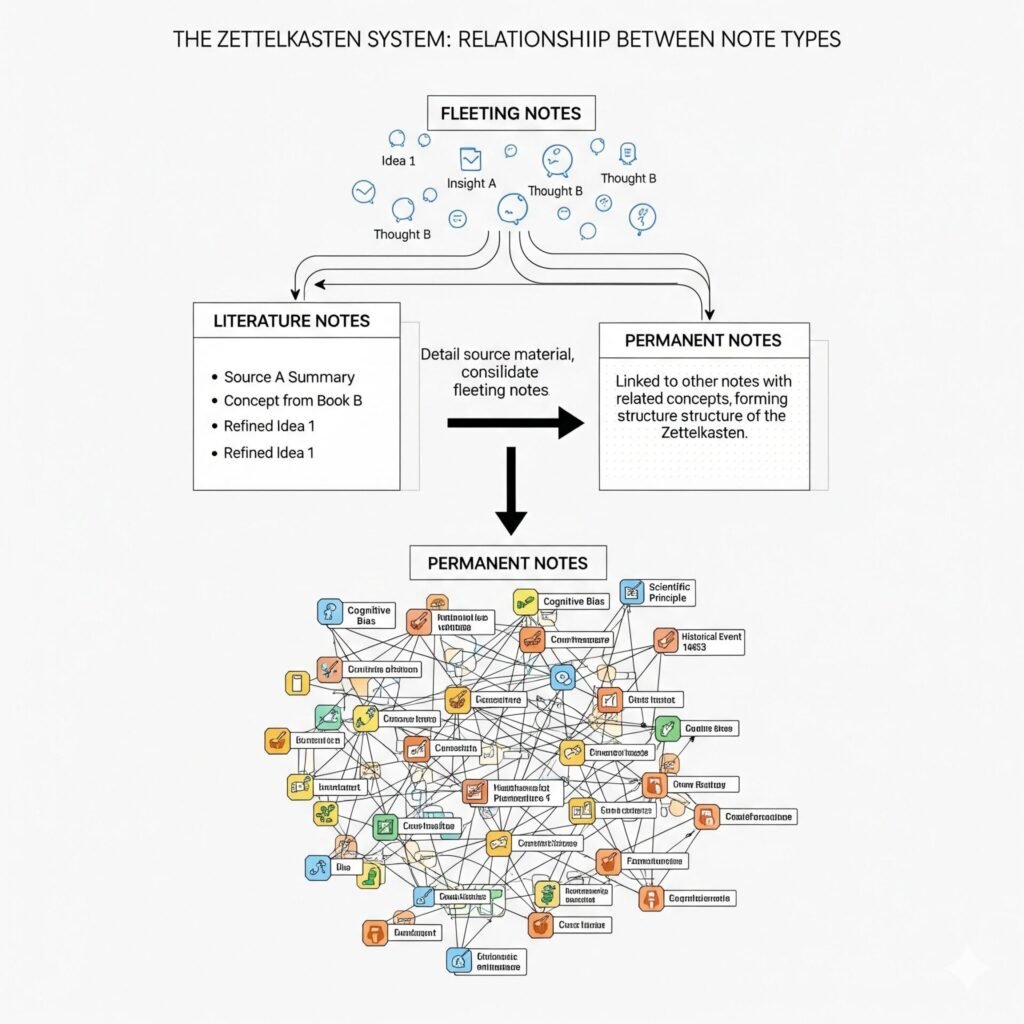
A Zettelkasten, like my own, consists of three different types of notes.
– Fleeting notes: These contain original ideas or thoughts, perhaps scribbled down or captured as highlights from content you’re consuming.
- Literature notes: These detail the source material from which you’ve captured ideas. I also use them to consolidate fleeting notes from a particular source.
- Permanent notes: These reside within your Zettelkasten and are linked to other notes containing related concepts or ideas. These links provide the Zettelkasten’s structure.
Why you need a PKM system?
I began this post by sharing my own experiences with information overload. As I alluded to, a PKM won’t completely eliminate the risk. My system still creaks under pressure at times. However, it provides a system for managing the content I want to consume and the notes I’ve taken, offering a degree of protection from information overload.
Knowledge is unique to each of us; we all have our own interests. Therefore, a PKM that works for one person might not work for you. In my experience, your system will grow and change as your needs evolve.
Maintaining a Zettelkasten has certainly aided my learning. I’m finding that when I read something, I’m reminded of other ideas already in my Zettelkasten, even if I don’t recall them perfectly. I can note the link so that later, when creating a permanent note, I can link the idea if it’s still relevant.
It’s also boosted my creativity and idea generation. Most of my ideas come from interacting with my Zettelkasten, such as creating permanent notes based on content I’ve consumed. These ideas are quickly noted and added to my content idea backlog for future consideration.
Key components of a simple PKM
A note-taking application sits at the heart of any PKM system. However, not all applications are suitable.
You need an application that supports backlinks, as linking related ideas is essential in any PKM. Ideally, the application will also support folders and tags.
I use Obsidian because it supports all three and can adapt to your evolving needs. If I were starting today, I’d still choose Obsidian. However, other alternatives are available for you to consider.
Whichever application you choose will become the home for your Zettelkasten.
“I’d recommend starting with the Zettelkasten first and considering how information will feed in once you’re comfortable. Once you’re familiar with using your Zettelkasten and feel the friction building, read my blog post From Information Overload to Knowledge Powerhouse: Building Your Personal Knowledge Management Stack.
Getting started: Your first steps
I’d suggest creating two folders: one for your literature notes and another for your permanent notes. For guidance on creating folders, read my guide on organising your notes in Obsidian.
Once you’ve created the folders, start capturing ideas and thoughts as fleeting notes. This post would be a good starting point.
Once you have some fleeting notes, you can create literature notes and permanent notes. I walk through this process in Creating a Zettelkasten system in Obsidian.
Just remember: a Zettelkasten is a journey, not a destination. My Zettelkasten isn’t finished and never will be. Even if I maintain the practice until I’m 100, it won’t be complete, as there will always be something new to learn.
The thought of the unexpected links I might encounter in 45 years, if I’m still alive and maintaining my Zettelkasten, excites me.
Lastly, as part of your Zettelkasten journey, it will evolve and require changes. Experiment with it, remain open to the ideas of others, and try them out if you think they could improve your system.
Conclusion
My hope is that this post has shown you how having your own PKM can help you manage the threat of information overload and has encouraged you to start your own PKM.
I’ve included links to some useful resources in the ‘Further Reading’ section to help you get started.
I’d also recommend joining our weekly newsletter to stay up-to-date on our latest content.
Further reading
- Introduction to the Zettelkasten system: An introductory guide to the Zettelkasten method.
- Cultivating your mind: The Digital garden compared with Zettelkasten: A comparison between Digital Gardens and Zettelkasten.
- Creating a Zettelkasten system in Obsidian: A guide on starting a Zettelkasten in Obsidian.
- Organising notes in Obsidian: A guide on how to organise your notes in Obsidian.
- From Information Overload to Knowledge Powerhouse: Building Your Personal Knowledge Management Stack: Learn how to build a personal knowledge management stack to control information flow.