
My journey of using Claude as a reading partner started on 9 October 2025. I was reading an entry in the Stanford Encyclopedia of Philosophy and came across the phrase “Constructivist Kantian direction”, which I didn’t understand.
I decided to ask Claude, and copied the paragraph into the Claude chat app on my tablet. In my journal entry for that day, I noted that I had enjoyed going down the rabbit hole with AI.
In the year or so since that first experience of using Claude as a reading partner, I have had around 50 conversations.
So what are the benefits of reading with Claude, and what does it cost me?
Why not just Google it?
You might be wondering why I don’t just Google it. That is a valid question. With a search engine like Google, you really need to have an idea of what you are searching for, and that’s something I don’t always know when I’m reading.
But what I can give an AI is context. I can quote the specific passage and ask what a word means in that context, which helps the AI to generate a response tailored to my specific query. At times, this response can take my thoughts on an interesting journey.
As I wrote in one of my own notes from using Claude, a large language model allows you to explore your thinking with little to no friction. Unlike a search engine, you don’t need to know what you are searching for. You just need to give the model context around your thinking.
It ties in with the idea of asking open questions as you read, because discussing the material with Claude helps you to start a dialogue with the source. It has another benefit too: to ask that question, you have to organise your thoughts.
Since Plato, philosophers have used dialogue to explore their arguments from different perspectives. Claude and other generative AI models are in a distinct position here. Because they have been trained on so much of human knowledge, they can act as a mirror on humanity. It’s an idea I explored further in my post AI: A Mirror Reflecting Human Bias in Society.
Having a conversation with an AI like Claude potentially offers a third perspective on the content I’m reading, on top of my own and the author’s.
This practice forms Level 2 of my AI Knowledge Framework, which I introduced in my post Introduction to my AI Knowledge Framework level 0.
How I organise my conversations with Claude
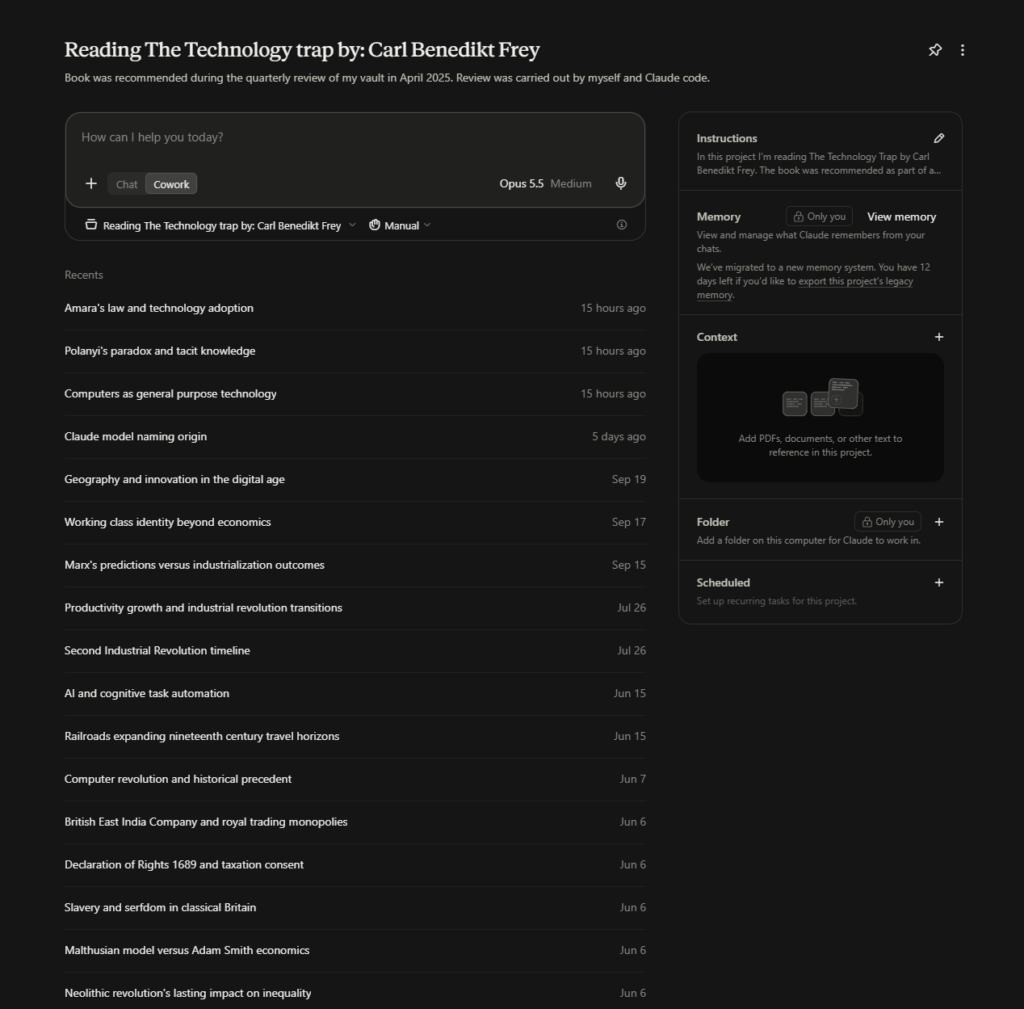
Since the start of the year, I have created a project in Claude for books and other long-form content. This gives me a single area for my exploration of that book. It doesn’t replace taking highlights and noting questions as I read, as those will form my source notes for that book.
I normally enter a prompt in the project instructions, which gives Claude context on what I’m looking to get from reading the book and from my conversations with Claude.
Once the project has been created, whenever I find a term I don’t know, an idea that seems important or worth exploring in future, or maybe the name of someone, I start a conversation with Claude and normally share the passage.
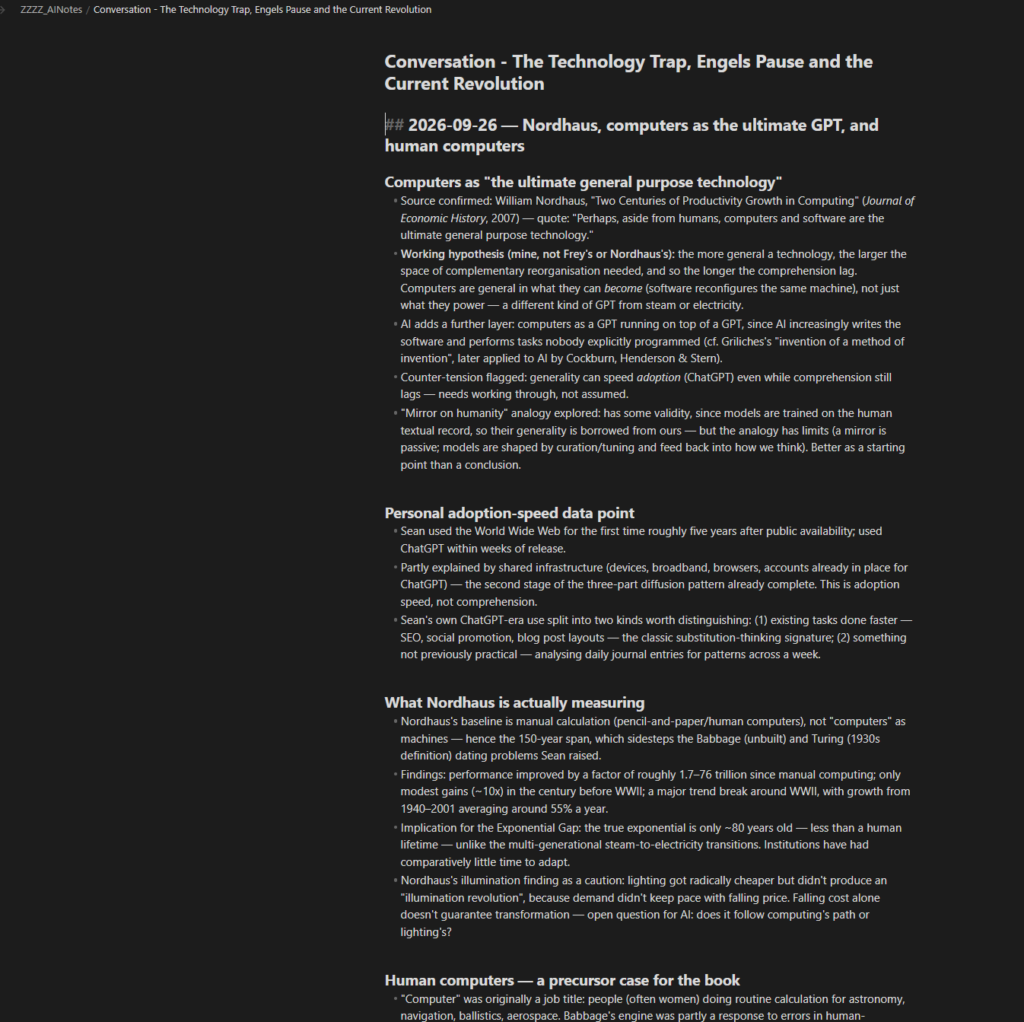
Informative conversations with some value will be saved to my vault. The process is described in “Claude keeps the record, I write the notes” below.
These conversations are treated as fleeting notes. They are the start of a process, not the final answer.
It argued back
One of the most important things, as far as I’m concerned, about using Claude as a reading partner is that it argues back, especially when I have misunderstood the source material or the context of the article I’m reading.
In April 2026, I was reading The Problems of Philosophy by Bertrand Russell, and our conversation turned to solipsism. In my response, I said it was probably acting as an introduction to the cogito. Claude politely stated that it was the opposite and explained why I was wrong.
Later in the same conversation, I ended up comparing solipsism and the cogito to a single-player game where everyone else is an NPC (non-player character). Claude praised my thinking, even though it had been instructed not to give false praise, but then went on to critique it and linked both ideas to the hard problem of consciousness.
I then went on to share a personal framework I had come up with to model what I had taken from them all: my idea that life is like a one-player sandbox, in that only you can decide what you want to do. It’s similar to an MMO like EVE Online, and now I was wondering if it was more like Skyrim, a single-player RPG.
My thinking shapes Claude’s responses, and its responses alter my own thoughts. New ideas can emerge from these exchanges.
Claude keeps the record, I write the notes
If I judge a conversation worth saving, I will ask Claude to save it. Claude should save it in ZZZZ_AINotes, a folder I created specifically for this purpose, as I want a boundary between my notes and those generated by AI.
But in most cases, it won’t stay there. I will move it to my fleeting note library for potential synthesis, and in a lot of cases I will want to synthesise it into permanent notes, like some of those used in the previous section of this post.
This is done by moving them into the AI Sources folder in my 4_Readwise folder, where they are treated like normal fleeting notes.
The idea is to synthesise the thoughts from my conversations with AI, and for me this is done best in the same way as I do with the thoughts and ideas of human authors, such as The Problems of Philosophy by Bertrand Russell, the very book where Claude questioned my understanding. To me, they are both sources of knowledge and understanding.
It also helps me and Claude to keep to my own red lines for using AI with my PKM. You can find out more in my post Introduction to my AI Knowledge Framework level 0.
What it costs
I suppose the biggest potential cost is that, if the AI’s responses are influencing my thoughts, I could be heading towards average thought. Some research into human-AI interaction has shown that the output of people who work with AI is less diverse than that of people who create something on their own.
Next is AI’s tendency to flatter you, which can lead to confirmation bias and a negative impact on your cognitive wellbeing. You can find out more in my post Cognitive Mirror Syndrome: Should We Be Concerned?.
As with all AI responses, there is a risk that it might make stuff up. I do think it’s less of a problem with current models, but it still happens. How do I know that Claude’s pushback on the cogito being the opposite of solipsism was correct? I didn’t at the time of the conversation, and I don’t think that is a big issue, as the conversation is about the ideas.
But later on, that fact could make its way into a permanent note, and misinformation could impact the quality of my Zettelkasten and the work I produce from it. That could be costly, not just to my knowledge but to my reputation.
It is, however, correct. Claude Code confirmed this when it did the initial layout for the post, and I checked it myself with Gemini. If an AI has told you something that differs from the original source and it’s important to you, check the fact with a search engine or get another AI to fact-check it.
Another cost comes from the fact that Claude projects are self-contained. I have mentioned related discussions from one book or long article in another, and Claude is unable to see the related conversation. It can be annoying at times.
Another cost that will probably grow is what Claude called “the pile” in the layout for this post, and that is as good a description as any. At the time of writing, 50 notes are marked for synthesis (the process I use to make permanent notes), and only eight have been made into literature notes.
Could I just be building a collection of ideas from these conversations and doing nothing with them? That is a very good challenge, and it’s a feature of the process. The fact is, the consumption of knowledge is a bit of a funnel.
It is easy to read books, highlight them and question those ideas in conversation with AI. The hard bit is synthesising these ideas into literature and permanent notes. It’s not helped by the fact that this is the part of my content system that gets squeezed by the pressure the rest of my life puts on my time.
So, is it worth it?
The short answer is yes.
As part of my journaling habit, I list up to three things that bring me joy, and thinking for myself is one of those joys. Claude is a tool that allows me to explore my curiosity and see where it takes me.
But that doesn’t mean you shouldn’t be mindful of how you use AI as a reading partner, so I’m going to offer you three takeaways from my personal experience.
- Let Claude keep a record of the conversation, but write the notes yourself. Make the outcomes your own.
- Be suspicious when it praises you. It has been designed to please its user.
- Encourage it to push back and tell you when it thinks your thinking is wrong, and don’t be afraid to push back either. Have a dialogue with it.
To be kept up to date with our most recent content, join our monthly newsletter.
Further reading
- How to Take Smart Notes by Sönke Ahrens: the book that encouraged me to question all the content I consume
- Introduction to my AI Knowledge Framework level 0: the red lines and Level 2
- AI: A Mirror Reflecting Human Bias in Society: explores the idea of AI acting as a mirror on humanity
- Cognitive Mirror Syndrome: Should We Be Concerned?: the flattery risk
- Can Your PKM Protect Your Cognitive Abilities from AI?: explores how a PKM can protect your cognitive abilities
- Claude Obsidian Workflow: My PKM Update (Part 3): the rest of my Claude workflow