
Last week’s post was triumphant. In this post, the last in our series about writing as a technology, we look at the downsides of writing. The same problems have been raised about every other knowledge-managing technology we have invented since, up to and including generative AI.
Socrates famously said that writing would help us to forget. The irony is that his student Plato wrote it down, it has survived for 24 centuries, and now, in the 21st century, a blogger is mentioning the story in a blog post about the downside of writing.
And that is because Socrates had a point: writing can have a negative impact on our memory. Similar arguments have been made ever since. The printing press and the Internet led to concerns about information overload. The calculator would lead to the decline of long division. The Internet, again, had a negative impact on our ability to focus. And last but not least, generative AI will take away our ability to think.
These are all genuine issues and concerns, but in previous cases they were often blown out of all proportion by the fearmongers. You can read about it all in my post We’ve Been Here Before – A History of Cognitive Concern.
There really are downsides to writing
The fact is there are downsides to writing, and Socrates was right that it has a negative impact on our memory. As we mentioned in last week’s post, writing got around our biological limitations around working memory by acting as a permanent memory.
The use of this external memory means there is less reliance on memorising things, as I can just note it down. We no longer notice this, as none of us alive can remember a time before writing was invented.
But the same effect has happened with the Internet, and it has even been studied and named: the Google effect. We have learnt during the last 20 years that knowledge and information can easily be found on the Internet. So we memorised where the information could be found, not the information itself. We are able to study this one because we are currently living through the change.
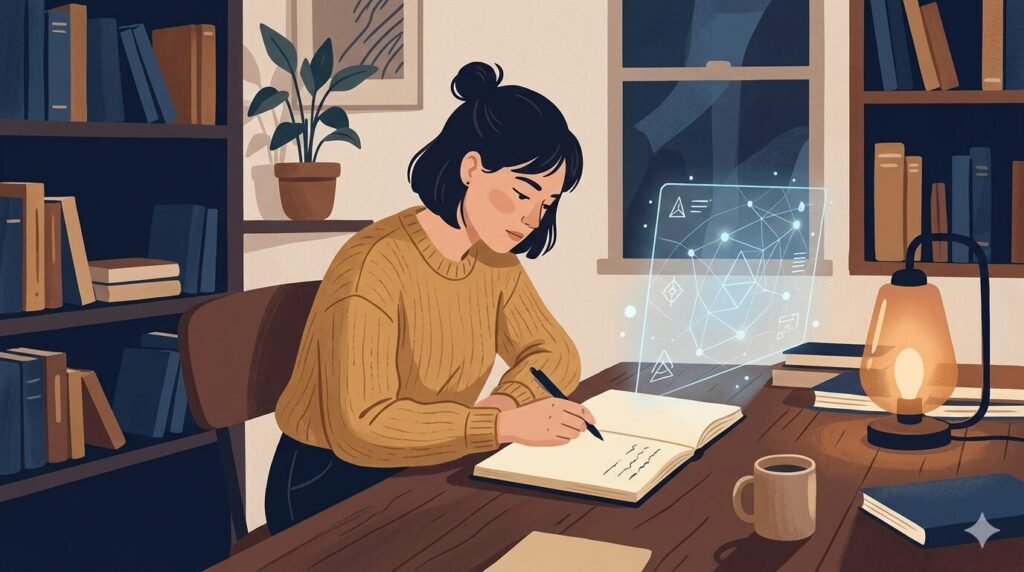
Surviving writing doesn’t mean we will survive AI
Our cognitive abilities survived writing, and later technologies such as the printing press, and probably the Internet too, although the effects of the Internet are still likely feeding through. That doesn’t mean they will survive the impact of AI.
Writing was, until now, only a human skill. It could only ever be written and read by humans. During the last decade or so this has changed with the invention of the Large Language Model (LLM), a variant of AI that learned to read. You can learn more about Large Language Models in our introductory guide.
We have invented a technology that can write its own content, and it does this by predicting the most likely next piece of text. But as Yuval Noah Harari put it, language is the human operating system. My post Navigating the Future: Insights from Yuval Noah Harari on AI and the Humanity explores Yuval’s concerns in more depth.
But the concern I want to explore in this post is what the cognitive impact will be of using a technology that can read like me. We will cognitively offload onto this new technology, and on its own that isn’t necessarily a problem. It is the same process that led to less effective memory when we first started writing.
This reduces our cognitive load, but what will we replace it with? With writing, we used the extra capacity to think and explore. Another upside of writing is that converting our language into the flat, concrete, abstract form of the written word forces us to think.
So if you are not going to replace this thinking with something else, what will happen to our minds?
Human AI conversation can be a cognitive feedback loop
The following section is based on a conversation I had recently with Claude while reading a research paper. The note states: “Conversations between a human such as myself and generative AI, such as a Large Language Model (LLM), can be seen as being a cognitive feedback loop. My thinking shapes the response of the Generative Artificial Intelligence and its response will alter my thoughts.”
I think the idea captured in that note is genuinely intriguing. The upside is that it could lead to us seeing things in a different way to our own individual perspective. AI is pretty much trained on the sum of human knowledge, so it could potentially give an indication of how humans on average see it.
While this averaging impact of the AI allows us to see a different perspective, it does have at least one potential issue.
Research has indicated that work created between human and AI is less diverse than work created by humans alone, which suggests that generative AI has a tendency to drift us towards average. I have written a post about my concerns on this: Knowledge Collapse: The Hidden Risk to Society.
The thing at risk is the thing you need
Reading is hard work because it doesn’t come to us naturally, but like your muscles it can be strengthened. If you develop a daily reading habit you can read more challenging works. I read most days.
When I first started my current reading practice I read mainly science fiction and fantasy. After I started writing my blog I moved on to non-fiction, and some of these books and articles can be quite challenging. That is what exercises my cognitive muscle.
This cognitive muscle helps you to make better use of modern technology such as Artificial Intelligence, as it helps you to both frame your inputs and analyse the outputs. It is a kind of paradox that Artificial Intelligence can weaken the same muscle, such as when you read a book summary instead of the whole book.
I explore this further in my post How to Protect Your Cognitive Abilities in the AI Age.
Conclusion
In the Writing as a Technology series we have considered why writing should be considered a technology, and then celebrated what writing has done for our species as I argued why it is the greatest technology we have invented. And finally we have considered the downsides, such as its impact on our ability to remember.
If the upsides of the new technology are greater than the potential downsides, we win.
It seems that reading and writing are just as important for us today as they were when our ancestors invented them, but now as a shield to help us both protect and continue to build our cognitive abilities.
If you enjoyed this series, why don’t you buy me a coffee? That would help me to continue writing content like this.