
I’ve just turned 56. I’m a member of Generation X, and I can remember life before the Internet. That gives me a perspective on the Internet and our cognitive ability that later generations who grew up with it will not have.
The first time I can remember using the Internet was as a 26-year-old student at my local college, trying to research something for an assignment. I used Yahoo for search, as Google wasn’t yet a thing. I didn’t access the Internet at home until a couple of years later, using a dial-up modem.
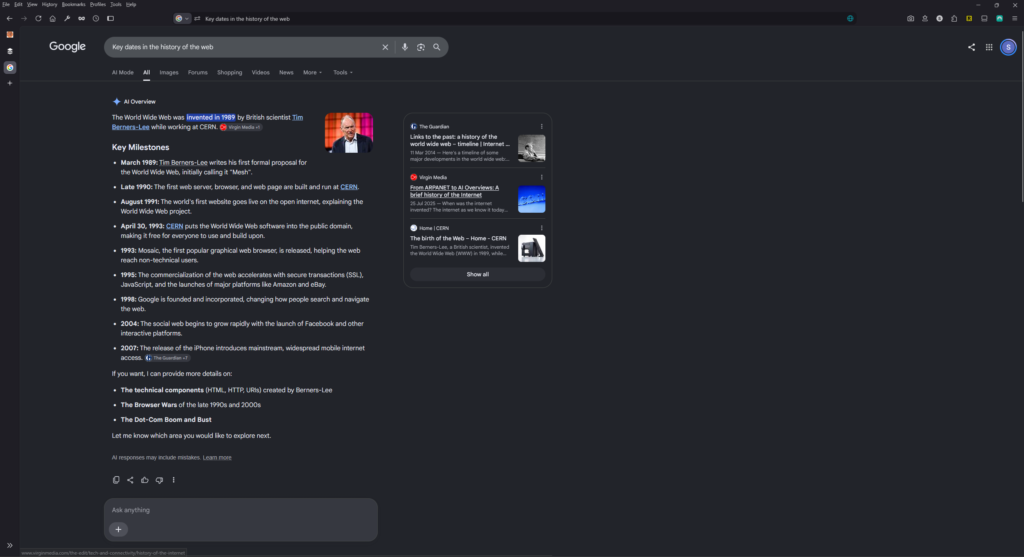
The Web, through which I was accessing the Internet, was only a few years old, and when I first used it there were some 16 million connected devices. By 2020, this had increased to 20 billion.
So while this post looks at some of the research I have read about the Internet’s impact on our cognitive ability, I consider it through my own experience of using the Internet, as someone who can remember what things were like before 1991 and the invention of the World Wide Web.
What I got
The biggest thing I have got out of the Internet is access to pretty much all human information and knowledge, much of which has been indexed by search engines. That allows me to retrieve the information I need, when I need it.
Before the Internet, I would have had to go to my local library to retrieve information. It seemed more important to remember what you had learnt, as there was an expense to looking it up again. Now there isn’t really any cost to looking up information again.
The Internet has allowed me to explore what I have learnt by blogging about it, in posts like the one you are reading now. The act of writing helps me to give my thoughts and ideas structure, and before the Internet my writing would have had no means of distribution.
It has also opened my mind to the thoughts and ideas that others are sharing, via resources like Wikipedia, blogs, podcasts and even YouTube.
Since the mid-1990s, I have had to learn digital native concepts that only have meaning in the digital reality we created with the Internet. These include:
- Search engines
- Social media
- Digital identity
But this did come at a cost, which we will explore next.
What it cost me
As with all things, there is a cost, and that cost is doom scrolling. First it was Twitter, and now it is YouTube. Before I started writing this section of the post, I was scrolling through YouTube videos that were of no importance to me, to get the dopamine hit. Dopamine drives our habits.
I even do it on my phone, scrolling the Google feed. At times it can be helpful, but again, I do it because of the dopamine hit. I try to stop it by reading an article on Medium instead.
It has reduced my ability to focus, often at the start of work, such as when I started writing this section. Thankfully, once I get going I’m alright. I don’t know if that is due to the focusing skills I gained before the Internet.
You might be thinking, why don’t you just stop using YouTube? But it can be a useful resource for learning something new. And the same can be said of whatever social media app encourages you to scroll towards doom.
But that isn’t even the biggest problem for society. The bigger problem is that social media has a filter bias, which is the mechanism driving the scrolling. It reduces our ability to see other people’s perspectives, and this could be very dangerous for our society.
Where I think the panic got ahead of itself
Yet I think the panic got ahead of itself. As you can see from the previous section, I know there is a problem. Hell, I’m fighting it every day myself. But have we really lost our focus? We are all still capable of binge-watching the latest blockbuster series on a streaming platform such as Netflix.
The Internet has also led to concerns about digital dementia, yet research indicates that using the Internet reduces the risk of cognitive impairments, such as dementia, in older adults.
These concerns are not just limited to the Internet, but extend to any other technology that impacts our cognitive abilities. You can discover more in my post We’ve Been Here Before – A History of Cognitive Concern.
The finding I can’t argue with
But there is one finding I can’t argue against, and that is the double whammy. First, we feel more confident about the things we know, caused by the illusion of knowledge: you think you have absorbed the content you are consuming, but that isn’t the case unless you really take the time to absorb it. And secondly, we have lowered our scrutiny of what we consume.
To me, this is a dangerous combination. But the solution is both simple and difficult. As I wrote in one of my own notes, you must question what you consume, and that is something I need to work on.
I also wouldn’t argue with the idea that the Internet has led to increased cognitive offloading. This in itself isn’t necessarily a risk. It really depends on what you are offloading, and what you are replacing it with.
It is pretty safe to offload the things you can do without thinking, or that you don’t really want to learn. But you shouldn’t offload the things you are trying to learn and haven’t yet mastered.
You also need to be careful with what you replace it with. If you replace it with something with the same or a bigger cognitive load, it will help you to develop your cognitive strength.
If you regularly offload things that you are still learning, or replace them with less demanding things, you risk building up cognitive debt. You must exercise your mind. I explored cognitive offloading further in my post Cognitive Debt: The Real Cost of Offloading to AI.
So what does this tell me about AI?
The World Wide Web first became available in 1991. I used it for the first time around 1996, and it took several more years for it to shape some of the changes I’ve described in this post.
ChatGPT went live on 30 November 2022. I tried it within the first couple of months, and you can read about my experience of using ChatGPT in my post ChatGPT my first thoughts. Thankfully, I could see the potential, but I didn’t think it was quite ready.
Now, some four years later, I am using iterations of the same technology pretty much daily. It helped me to lay out this post, and I use it as a reading partner when reading complex stuff. My post Claude Obsidian Workflow: My PKM Update (Part 3) will give you some idea of how I currently use AI.
You have to wonder what impact AI is going to have on us, especially now that we have an idea of how the Internet impacted us.
I think this line from earlier, which came from one of my own notes, rings even truer now: you must question what you consume, and that is something I need to work on.
Why don’t you join me on my journey of discovery as we travel through one of the biggest periods of technological change in human history? The Internet age has barely started, and we could already be entering the age of AI.
You can join me by signing up for my monthly newsletter.
Further reading
- We’ve Been Here Before – A History of Cognitive Concern: A post that explores the number of occasions we have become concerned about the cognitive impact of new technology
- Ourworldindata.org, Internet
- Aaron French, Is ChatGPT Making Us Stupid: One of my sources for the Google effect
- Claire Mason, Dumbing Down or Wising Up: How Will Generative AI Change the Way We Think: Source for some of my own notes on how our thinking was impacted by the Internet
- Molly Glick, AI Might Not Harm Us in the Way You Think: Source for digital dementia and the fact digital technology appears to reduce the risk of it
- ChatGPT my first thoughts: A post in which I describe my first experiences of using ChatGPT
- Cognitive Debt: The Real Cost of Offloading to AI: A post exploring whether cognitive debt is the real cost of offloading to AI