
In a 2024 post, I wrote that a PKM lets you filter the stream. What I never said was how much of the stream actually gets through. Looking back, I think that’s because, until this year, I had no idea how little of my information stream gets synthesised.
One of the metaphors that really stuck with me came from Mike Caulfield’s blog post The Garden and the Stream: A Technopastoral, which describes information flowing as a stream into a digital garden.
In that 2024 post, I noted that the stream of information isn’t just social media. It’s any content we decide to consume, and it has the potential to cause information overload. The solution I gave was to filter it, and that this is where a PKM comes in. I now think that’s only half of the story.
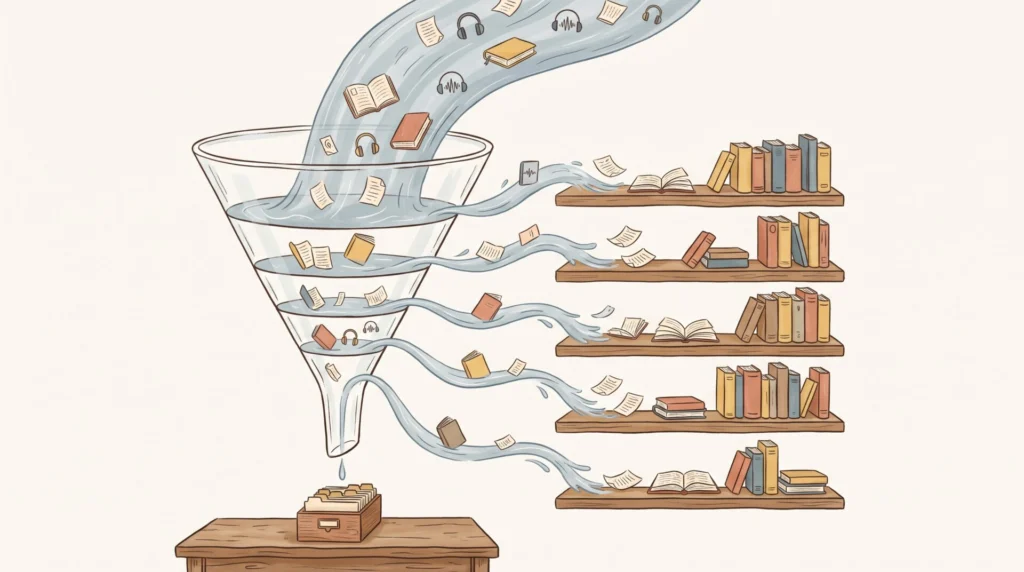
The funnel narrows at every stage
I’ve written about this in other posts this year, but my synthesis process has changed significantly in 2026, and the current system has changed my views on what it means to learn and take notes.
An example of this is my current ratio for fleeting notes generated from listening to podcasts: only 1 in every 16.9 podcast notes is put forward for synthesis. Each podcast episode gets its own note.
The consumption layer
Most of the content that’s likely to end up as permanent notes reaches me through digital media: e-books read on my tablet, articles saved to the Reader app or read on Medium, and podcasts listened to on Snipd.
The consumption layer is where the first filter sits, as this is where I decide what to consume. With Reader, Snipd and Medium, I shortlist a set number of items, because I know from experience it can be demoralising if you let them build up too high.
I find this especially hard on Reader. I think that’s because it’s my main collection app, but I try to keep the shortlist to content I think will be most helpful for my writing, or something that really intrigues me.
What I highlight
The second filter is applied while I’m consuming, when I make highlights, be it in the Kindle app, Reader or Medium. In Snipd, I can “snip” part of a podcast, which creates a note based on the section I was listening to.
All these highlights are collated in Readwise, and from there they’re synchronised with my Obsidian vault. Every piece of content I’ve consumed gets a note created in my vault by the Readwise sync.
This part of the system has had the biggest and most positive impact on my PKM. Without it, I might have stopped keeping a PKM by now.
But Readwise isn’t the only source. As I shared in a recent post on reading with Claude, notes are now being created from those conversations too, and many of these could be synthesised into my vault.
I’d consider all of these fleeting notes, but most of them are fated to remain in my library. Only a few will be synthesised into permanent notes.
The synthesis process
This is the part of the process that has changed the most this year, because until this year I never really had one. It has already been through a couple of modifications, and my biggest takeaway is that most of my fleeting notes will remain in the library, never getting synthesised, as I don’t have the mental capacity to do so.
The synthesis process is managed using the official Obsidian Bases plugin, and the views are built on the notes’ properties. Every note created by the Readwise sync has an intent property, and its value is set to inbox.
At regular intervals, I check these notes and decide whether they should be synthesised or kept in the library, and I try to be quite ruthless at this stage.
Notes that will be synthesised have their status changed to backlog and their intent changed to synthesis. I’ve also recently started setting the priority to high or medium, depending on how important I think completing the synthesis is at the time.
Each Saturday morning, I look at my shortlist of notes to be synthesised. If I have fewer than 10 notes waiting to be processed as fleeting notes, I add more until I reach 10.
After that, I get AI to check any notes marked for synthesis that are older than 90 days, selecting a maximum of 12 for review, each with a recommendation on whether I should still be looking to synthesise it or demote it to the library. This helps me keep the process as streamlined as it can be.
The rest of the process is as follows:
- Once I’ve highlighted the most important parts of the fleeting note, I change its status to processing literature note
- Once the literature note has been created, the source fleeting note is changed to the reference status
- From the literature note, permanent notes are created and added to my Zettelkasten
The bottleneck is the triage
The bottlenecks and tension in my system are where the triage happens.
The first time I feel it is when trimming and adding to my reading shortlist in Reader. Practically every week, I remove something I think I should be reading, and it goes back into the read later pile, as I only have a limited amount of time to read. Strangely, I don’t normally feel the same friction on Kindle, Medium or Snipd.
The second time I feel it is when choosing the notes I want to synthesise, and I think this is even more difficult. There’s even more time pressure at this end of the process, so the funnel is narrower and the rejection is greater. It means that, on occasion, I have to put aside things I really need to read.
But these tensions have eased thanks to a realisation I had while working on this year’s synthesis changes. Putting notes into the library or the read later pile isn’t failure. It’s my system working as it should.
What I’m still figuring out
My biggest fear is that my library becomes a graveyard, and notes once put there never get the chance to be synthesised. If that’s the case, it’s nothing but an archive.
Some of those notes in the library could well become relevant as my interests change and develop over time. What I’m still to resolve is how these library notes get the opportunity to be uplifted to synthesise in the future. Is it AI, is it me, or is it some kind of combination of us both?
Conclusion
The fact is, I can’t synthesise everything I capture. It would be a challenge even if I were immortal, as the content to consume will always outweigh the time I have to do it.
Do you try to process everything you consume into your PKM, or have you made peace with the fact you’ll never be able to?
If you enjoyed this post, why not consider joining our monthly newsletter to keep up to date with the latest content I publish?
Further reading
- Understanding Information Overload: A post I wrote in 2024 about what information overload is and how a PKM could help you manage it
- The Garden and the Stream: A Technopastoral: Mike Caulfield’s post on keeping a digital garden and the stream of information flowing into it
- Snipd Review: My review of the Snipd app that I use to listen to podcasts
- How to get started with Readwise Reader: A blog post explaining how I have set up Readwise Reader
- Getting started with Obsidian bases and properties: My post on how to get started with Obsidian Bases and properties