
This is the first post in our new series of five posts in which we explore why technology is outpacing society and what that means for us.
You have likely heard of Moore’s law. Gordon Moore, one of the co-founders of Intel, put forward a hypothesis in 1965 that the performance of silicon chips would double every 18 to 24 months.
Between 1971 and 2015, the number of transistors in a computer processor multiplied 10 million times. That is what exponential technology looks like.
Not all technology is like that. Take car fuel efficiency, which has only improved slightly in the 12 years that I have owned a car. That is an example of gradual improvement.
What Is Exponential Technology?
Azeem Azhar, in his book Exponential, defined exponential technology as a technology that improves by 10% at around the same fixed cost for several decades. Moore’s law remaining true between 1971 and 2015 is an example of exponential growth.
He defined four key areas where technology is improving exponentially:
- Computing
- Energy
- Biotech
- Manufacturing
In each of these areas, general-purpose technologies have recently emerged. A general-purpose technology can have a massive impact on our societies and disrupt the economy.
Historic examples include the printing press and electricity. One modern example from the field of computing is the Internet, the very technology that is allowing you to read this post.
What Is Driving Exponential Growth?
Technologies that grow exponentially are driven by three distinct forces:
- Wright’s Law
- Combination of exponential technologies
- Networks
Wright’s Law
Wright’s law was developed by Theodore Wright, an aeronautical engineer who noticed a pattern between the cost of building airframes and the drop in costs as production increased.
Wright’s law states that for every doubling of production, costs will fall by a constant percentage, with the exact percentage determined by the engineering in question.
Take computers: in the late 1960s, a computer would have been used by large organisations as no one else could afford them. By the early 1980s, they were cheap enough for people to have in their homes.
I got my first computer, a Sinclair ZX Spectrum, for Christmas in 1982 because of this. A gift that sparked a lifelong interest in computing and technology, all made possible by Wright’s law.
The combination of exponential technologies
Innovation is reliant on a combination of existing technology and existing knowledge.
At times one exponential technology can help drive the growth in another exponential technology. An example of this is AlphaFold, an Artificial Intelligence (AI) model developed by Google DeepMind, which analysed the genome sequences of various species to identify 200 million proteins for biologists to research.
This is an example of multiple crossovers between computing and biotech, not once, but at least twice, as the original genome mapping projects were driven by increasingly powerful and cheaper computers.
Networks
By networking, I mean the flow of ideas and knowledge between people. This sharing of ideas can help drive new innovation, leading to hubs of innovation around specific technologies, such as Silicon Valley in the US.
But this networking effect isn’t just limited to location, it can also be driven by technology. I’m currently reading The Technology Trap by Carl Benedikt Frey, and in a section about the impact of the railways on the Industrial Revolution I realised how much of a change it must have made.
Before the building of the railway network, it would have been difficult and expensive to travel more than a few miles from your home. The railway would have suddenly expanded your horizons.
The Internet has done the same but it has opened your horizons to fresh ideas and even virtual worlds.
The S-Curve Caveat
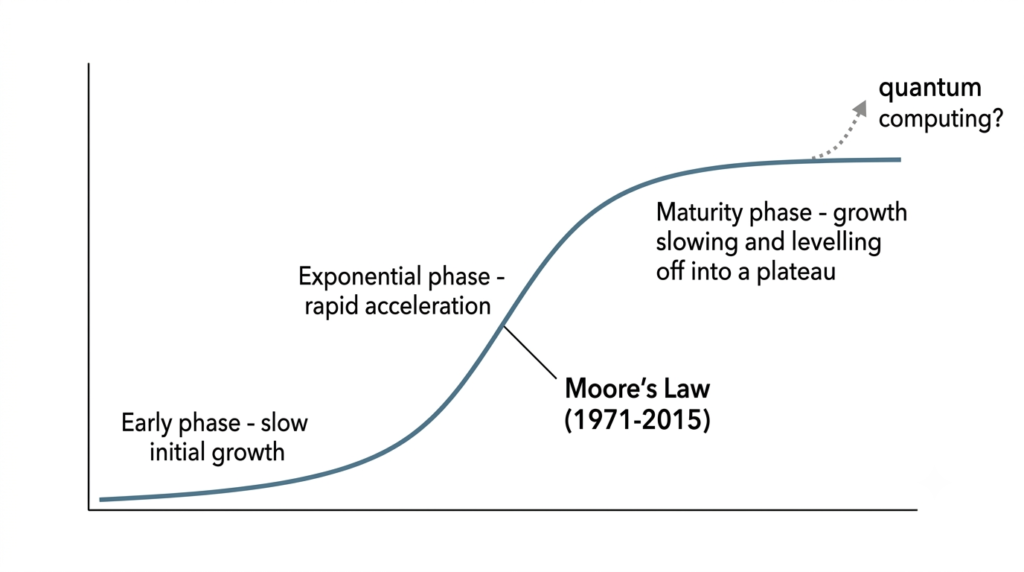
The development rate of a technology often forms an S-shape. At first it grows exponentially as the quick and easy improvements are made, but at some point these improvements slow and the curve levels out.
In computing, Moore’s law is expected to be broken as improvements to silicon processors are starting to slow to around doubling of performance every three years, an early indicator that its doubling time is starting to increase.
But when it does, other possibilities wait in the wings to continue exponential growth, such as quantum computing.
Conclusion
In this post we have explored what exponential growth is and how it is driven by exponential technology. But what does this mean to me, you and the rest of our society? That is the question I will be exploring next week’s post.
Further reading
- Azeem Azhar, Exponential
- Carl Benedikt Frey, The Technology Trap