
Intelligence without knowledge is like an engine without fuel. And that is probably why I have developed an interest in what knowledge is and how it can help me to learn, since I started my Zettelkasten.
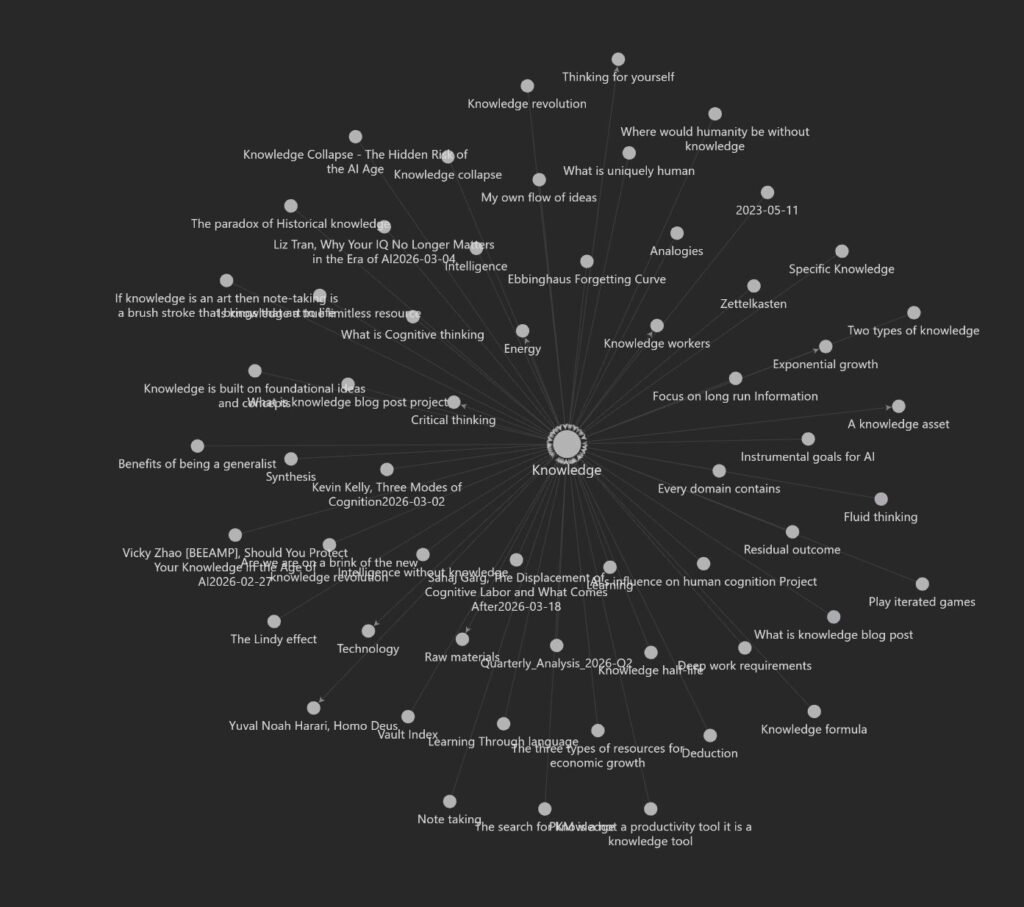
The next few paragraphs are from my permanent notes on Knowledge.
Knowledge is the driving force of the modern world. It has helped us overcome the limiting factors of raw materials and energy, as knowledge workers lead the search for new technology, driving exponential growth. This thought came to mind when making permanent notes from Yuval Noah Harari’s Homo Deus.
Knowledge can help you develop your own critical thinking and think for yourself.
Knowledge is made up of various knowledge assets, such as my Zettelkasten.
All of this is true and at least in part answers what knowledge is. But I think I’m missing something from this definition, and maybe that is why I wanted to write this post.
Defining Knowledge (It’s More Contested Than You Think)
As I hinted above, it’s a more difficult concept to tie down than you might think, as my own Zettelkasten notes have already shown.
At least in part, this could be because the formula we have used to define knowledge has changed over the years. In Homo Deus, Yuval Noah Harari claimed that in medieval Europe, knowledge = scriptures x logic. But during the scientific revolution, it changed to knowledge = empirical data x mathematics.
Again, this is a reasonable point, but I think it’s only part of the answer.
The closest I have come to explaining what knowledge is, is that it is built up from the foundational ideas and concepts I have learnt, mixed in with my own experiences.
Not All Knowledge Is the Same
Most people, including myself before I started to learn more about knowledge, thought all knowledge was the same. But that isn’t the case.
I have come across descriptions of three distinct types of knowledge. The first two are the more classical categories of knowledge.
Firstly, we have tacit knowledge, which can only be learnt by undertaking the activity itself. Examples of this type of knowledge include riding a bike or learning to drive. These types of activities are difficult to explain to another person through words alone. You have to actively do it.
Secondly, we have explicit knowledge, which is more abstract. It can be shared by one person teaching another, including through the written word. The concept of knowledge itself is an abstract idea that we can discuss with each other in writing, just as in this blog post.
The third type is specific knowledge, a concept put forward by Naval Ravikant. It is knowledge that is specific to you. It’s a combination of your genetics, upbringing, and, I would add, your lived experiences.
I wonder if my perspective on life is a combination of these three types of knowledge? The thought has just come to me while writing this section. I’m going to park it here for now, but I might explore it in a future post.
Knowledge Isn’t Given: It’s Built
To gain knowledge, we first need a problem to solve, which forces us to devise concepts and theories we can use to solve that problem.
Sometimes we don’t have the concepts or theories at hand to solve a problem, which leads to the search for knowledge. Seneca, in a letter from a Stoic, argued that the best place to start is to study the writings of others to learn what they already know.
Today we have so much opportunity to access knowledge, not just through the written word as in this blog post, but also in audio and visual formats. This can lead to problems of information overload, which I have previously explored in my post Understanding Information Overload.
But what do you do with the things you learn? After all, it is highly likely that you will learn things that don’t help you solve your current problem. This is done by creating knowledge assets, which you can refer to at a later date.
My knowledge asset is my Personal Knowledge Management (PKM), which is based on the Zettelkasten method. A Zettelkasten is made up of three distinct types of notes.
- Fleeting notes. The original idea or highlight taken at the time you come across it.
- Literature notes. Details on the source material when the original idea or thought came from something you have consumed. I will often summarise the key points in my own words.
- Permanent notes. These are written in your own words based on a single concept or idea, and are understandable on their own.
But the core aspect of any Zettelkasten isn’t the collection of permanent notes; it is combining them through backlinks. You can think of permanent notes as individual Lego bricks and the links as the connectors between them.
These assets are available to me when I need them.
Knowledge in the Age of AI
In the previous section, I introduced you to the concept of knowledge assets and to my Zettelkasten, where all the knowledge assets it contains form a knowledge base, which acts as an external store for my knowledge.
The fact is, this has become even more important in the age of AI. If you are not careful, extended use of AI can reduce your cognitive ability. A PKM, due to the way it works, can help you strengthen your cognitive ability.
No one is saying that you shouldn’t use AI. I use it every day. But there is a paradox with the technology. To get the most out of it, you need some knowledge about what you are asking, along with good cognitive ability. Yet its use can weaken those very abilities.
That is why I have my red lines, which you can read about in Introduction to my AI Knowledge Framework level 0.
What Understanding Knowledge Changed for Me
“Knowledge is freedom, ignorance is slavery” is a quote I took from a Ryan Holiday Medium post Do You Know How to Do a Deep Dive?.
I added this to the note I made from this quote. “To ensure I remain free I need to keep learning about the world around me while accepting that I will remain ignorant of many things. I need to explore the things that interest me by following my curiosity.” To me that reads almost like a mission statement for the rest of my life.
I started to write before my Zettelkasten, but the journey of discovery began with it. The discovery of knowledge is the key reason why I write now. This very post is an example, raising the question of whether my perspective is founded on the different kinds of knowledge.
If anyone else finds it helpful, that is an added bonus. If you enjoyed this post and wish to follow my journey and see where my curiosity takes me next, please sign up to my monthly newsletter, which includes summaries and links to the most recent posts.
Further reading
- Yuval Noah Harari, Homo Deus: Book referenced in this post
- Understanding Information Overload: A post I wrote about what information overload is and concepts on how we could manage it.
- Binny V A, Zettelkasten and the Art of Knowledge Management: Book on the Zettelkasten method referenced in this post
- Eric Jorgenson, The Almanack of Naval Ravikant: A Guide to Wealth and Happiness: The source for one of the specific types of knowledge
- Communicating with Slip Boxes: An article by Niklas Luhmann on how he used his Zettelkasten
- Introduction to the Zettelkasten system: My guide on the Zettelkasten method
- Hao-Ping (Hank) Lee, Microsoft Research, The Impact of Generative AI on Critical Thinking Self-Reported Reductions in Cognitive Effort and Confidence Effects From a Survey of Knowledge Workers: Link to the quoted research paper
- Introduction to my AI Knowledge Framework level 0: The post in which I introduced my PKM and AI use framework
- Do You Know How to Do a Deep Dive?: The source post for the Ryan Holiday quote