
After you have started using a Zettelkasten for a while, you will notice that some notes will be linked to more than others. These are a sign of a structure emerging within your notes. They are an indication of where your interests take you.
Sometimes they are no surprise, such as Zettelkasten and Artificial Intelligence being hub notes in my vault.
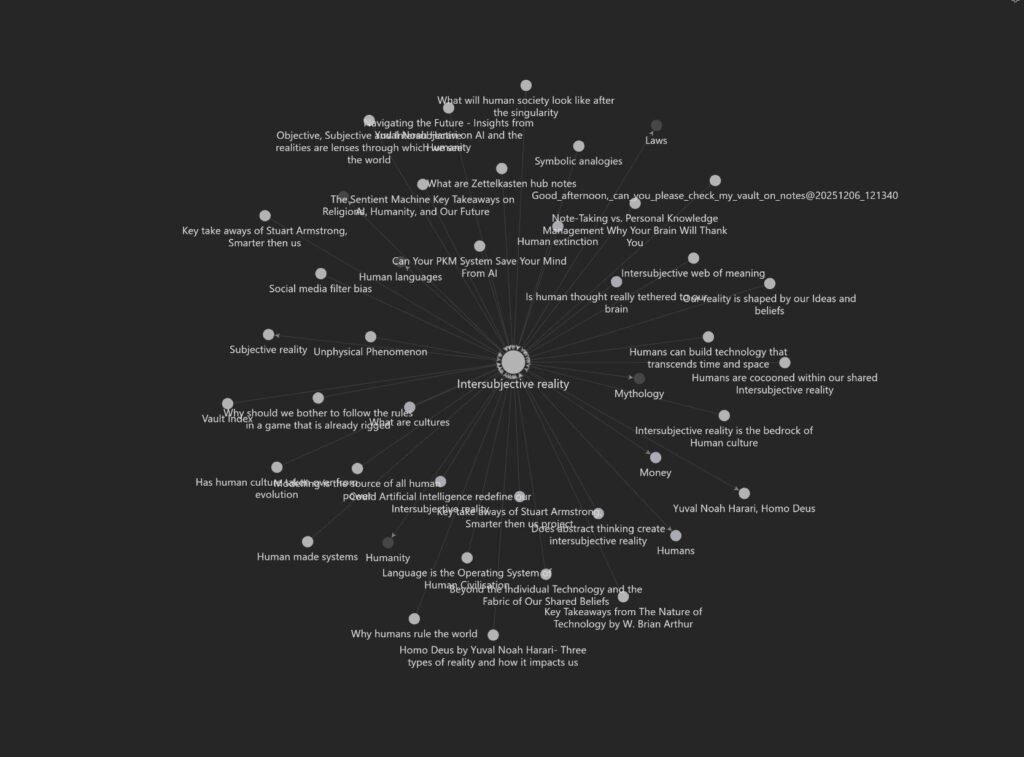
It’s the ones that surprise you that can deliver the most value. One example of those for me is the concept of intersubjective reality. I couldn’t really remember what it meant when I had finished reading Yuval Noah Harari’s Homo Deus. Yet it became a hub note due to me linking to it all the time.
Intersubjective reality, due to becoming a hub note, has ended up being written about in several blog posts I have written including Homo Deus by Yuval Noah Harari- Three Types of Reality and how They impact us. That is what a hub note can do for you and your vault.
Your Zettelkasten is growing, but where is everything
When you start a Zettelkasten, it can be an uneasy feeling because there appears to be no structure as you create your notes in a single folder and start linking your permanent notes. But there appears to be no structure, and you wonder: how will you find anything?
As Niklas Luhmann said, “Is a combination of disorder and order.” and it is out of this very disorder that the structure emerges organically, forming and changing as you link related permanent notes creating a web of what you know.
Each of these links opens up more ways to retrieve their contents in the future, and some of these connections will highlight hub notes in your network of ideas.
Discovery: What are hub notes
Some of your permanent notes will emerge with more links than others, creating hub notes. These can indicate core ideas in your knowledge which are, in most instances, worth exploring further.
A perfect example of this, as I mentioned earlier, is Intersubjective reality. It only really became ingrained knowledge due to it becoming a hub as I connected other notes with it.
As I use Obsidian, which supports backlinks, you can navigate the links both ways so these notes can be revisited in the future.
Hub notes grow organically out of your thoughts, ideas and knowledge.
Distinction: Hub Notes Vs Map Of Content
A Map of Content (MOC) is another way of organising your vault, but it is you trying to bring structure to your vault. It was a concept developed by Youtuber Nick Milo.
The table below shows the key differences between hub notes and MOCs.
| Hub Notes | MOCs (Maps of Content) | |
|---|---|---|
| How they form | Emerge organically from linking | Deliberately created by the author |
| Trigger | Density of links around a topic | Conscious decision to build a map |
| Origin | General Zettelkasten concept | Nick Milo’s concept |
| Role | Discovery: find unexpected clusters | Navigation: map known territory |
Neither approach is better. Hub notes grow organically from your notes, and as your Zettelkasten matures, they will just start to appear.
A MOC is a conscious decision to build a map, made by you, the owner of your Zettelkasten. There is no issue with having both in your system, which is why mine has both.
Practical Takeaways
You can enforce your own structure on a Map of Content based on how you see your vault, and at times you will have a good reason for doing this.
But in most cases, a better alternative and the way I normally proceed is to use the hub notes I identify to guide the structure I determine.
The concept of Intersubjective reality appears in my Map of Content and will list any note in my vault tagged as Intersubjective. However, you need to ensure that you update the hub note, which I hadn’t done with my Intersubjective note until this very moment.
Why don’t you check your Zettelkasten and identify your hub notes?
Further reading
- Yuval Noah Harari’s Homo Deus: The book that introduced me to the idea of intersubjectivity
- Homo Deus by Yuval Noah Harari- Three Types of Reality and how They impact us. A blog post I wrote about the key takeaways I took from Homo Deus including the three types of reality defined in the book
- Why I Consider Backlinks to be Critical in a Personal Knowledge Management System: A post on why I consider backlinks to be so important
- Unlock Your Mind: Recalling Knowledge with a Personal Knowledge Management System: A blog post about recalling my knowledge including MOCs