
I still use Claude chat as it can be really helpful in certain circumstances such as when I have a query about something I’m reading, but at times it can be really frustrating as it has very little context on who I am and what my personal interests are.
Claude does provide a system prompt, internal memory and the use of projects which does allow me to give more context on who I am, but there are limitations with this.
But imagine if it had access to my Personal Knowledge Management system and journals. It would give AI access to so much context on who I am which it could access as and when needed. Every output it produced would be created for me, not the generic masses.
Two mirrors facing each other
Amir Husain in his book The Sentient Machine argued that there would be a period of time before the emergence of Artificial General Intelligence when it would act as a mirror on humanity. I think we are now living through that period of our history.
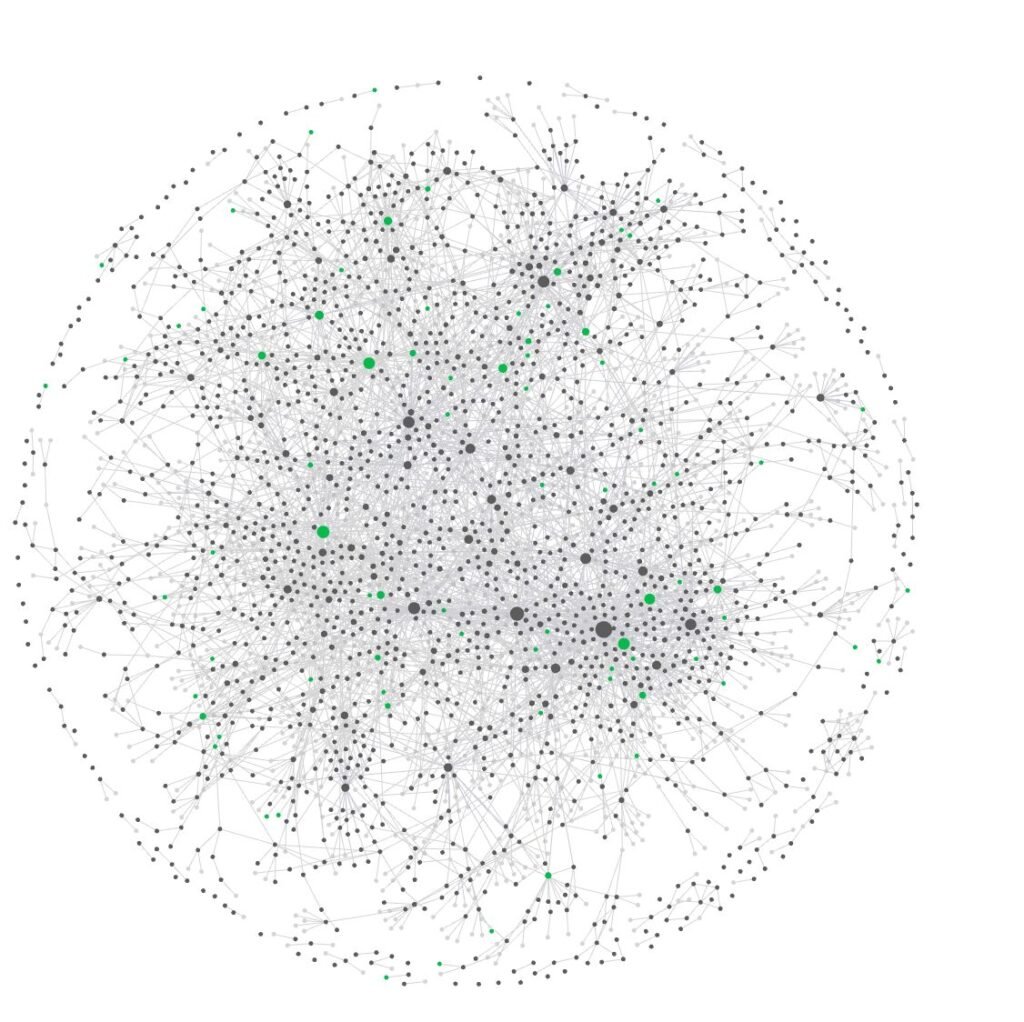
A PKM like my Zettelkasten isn’t a productivity tool. Its objective is to help you embed knowledge. The permanent notes and backlinks contain information on my interests and thoughts, so it can be considered a mirror reflecting who I am.
So, on one side I have a mirror based on my PKM reflecting me and on the other side a Large Language Model acting as a mirror on humanity.
Why AI needs your context
I recently published a post Context Engineering vs Prompt Engineering Explained, as my biggest takeaway from using AI over the last 12 months is that context is the most important thing. That isn’t to say that a good prompt isn’t important.
But good context can often make up for a poor prompt. That is why frontier models like Claude, ChatGPT and Gemini have a memory.
However, there is a limitation: the context window for a Large Language Model is finite and contains the conversation history and while the limits are now large, often being equivalent in size to a large book, performance can degrade before you get to this maximum limit.
You might be wondering how your vault fits into this. If you think about it your vault will contain enough information to give context about you and your interests.
If, like me, you use it to keep a journal, it gives context on what you are trying to achieve and other interests that you are interested in.
And if your PKM is in Obsidian the local Markdown files can be easily accessed by agents running on your local machine such as Claude Code. Of course, the processing will occur on the Anthropic servers.
What will this look like in practice
I don’t think we have reached a final solution yet, but a lot of the building blocks are here, it’s just a question of figuring out how to put it together. I’m going to share my experiences with you as an example of what it could look like.
My PKM was built using an application called Obsidian and consists of my
- Zettelkasten
- Journal
- Blog posts I have written since around 2022
- Content scheduler
- Unprocessed notes received from highlighted digital notes via Readwise
You might be wondering where the AI comes into all of this?
It is another layer which sits on top of my PKM independently. I have used Obsidian community plugins with AI capabilities such as Obsidian Co-pilot. And since the end of last year I have also used Claude Desktop via a Model Context Protocol (MCP) server. Or, alternatively, Artificial Intelligence running in the terminal in that folder with direct access to my notes, such as Claude Code and Gemini CLI.
MCP is an open standard developed by Anthropic that allows a Large Language Model to interface with another application. It has since been adopted by both OpenAI and Google DeepMind.
It allows me to interact with my vault and notes from within an external AI. You might be asking what can you do with AI? And probably more importantly is there any risk?
We will look at the second question in the next section as there are indeed some risks that will need to be managed.
But I’m going to finish this section of the post by answering the first question by sharing some brief examples on how I use AI.
- Maintaining an index of my permanent notes, which you can read about in my post
- Laying out blog posts including this one
- Editing my blog posts
- Editing and writing the summaries of content I have published for my newsletter
- SEO and social media promotion of my posts
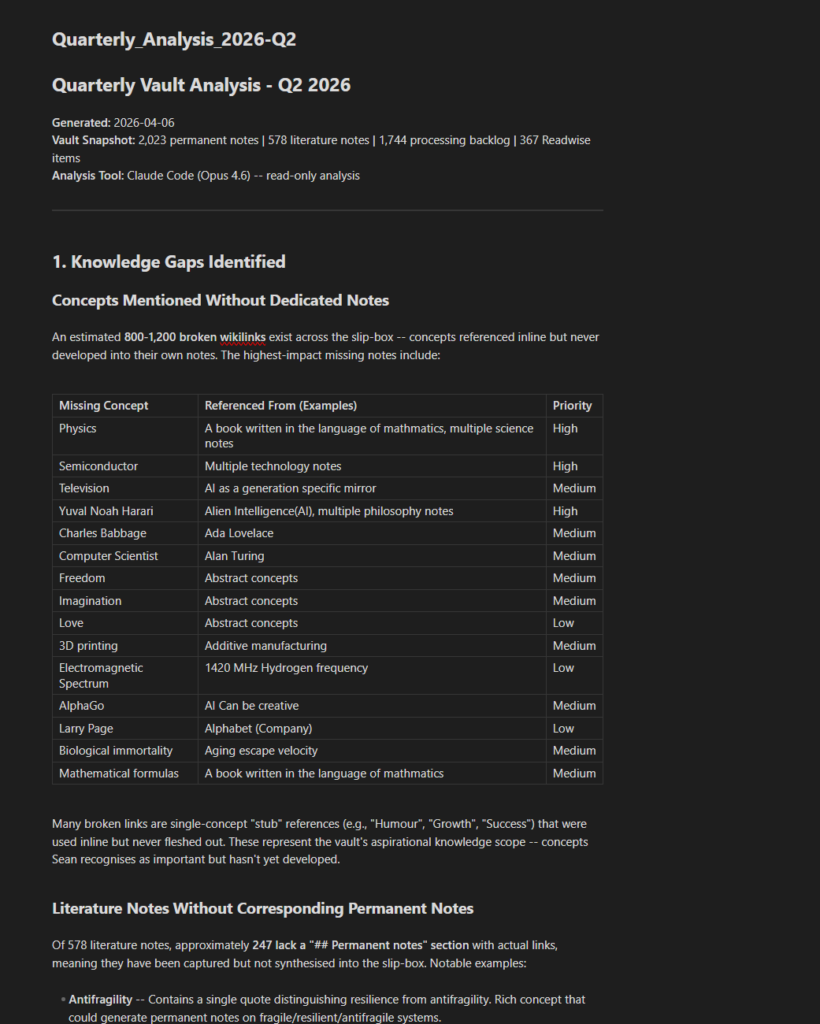
- Quarterly auditing of my vault, which you can read about in my post
- As a second opinion for backlinks
- Saved conversations regarding books I have read.
The Potential risks of using Large Language Models
As I stated previously, there is a risk to using Artificial Intelligence Large Language Model and I want to cover it in this section.
The cognitive risk
Current research such as Hao-Ping (Hank) Lee, Microsoft Research, The Impact of Generative AI on Critical Thinking Self-Reported Reductions in Cognitive Effort and Confidence Effects From a Survey of Knowledge Workers indicates that Generative Artificial Intelligence (Gen AI) has the following impact on critical thinking:
- Reduces perceived effect on critical thinking
- Encourages Overreliance on AI
- Creates less diverse outputs compared to humans.
The human mind has two modes. System 1 thinking is the stuff you already know and you might even do it on autopilot. System 2 thinking is used when you are still learning something and this requires cognitive effort.
You should be able to safely offload anything that is system 1 thinking to the AI, while you might want to consider what system 2 thinking you hand over. And if it’s something you regard as important to you, never let the AI do it for you.
Your Zettelkasten can protect you from this risk, but only when you use AI with consideration and keep the core cognitive work for yourself.
I have three red lines for my PKM which I introduced in my post Introduction to my AI Knowledge Framework level 0.
- I write my literature notes
- I write my permanent notes
- I add all backlinks, though AI can recommend them.
Any notes created during interaction with AI are saved to an AI-specific folder, and if I decide to process them, they are tagged to show that AI was involved.
I also have a red line around the writing of my blog posts. I write the first draft, which I have bent twice by including AI-generated tables, as they matched what I was writing perfectly.
The security gap
Security and confidentiality are obviously important and, like me, you will need to make your own decisions based on your own requirements after carrying out your own investigation. I’m not a security expert, so look elsewhere for discussions on security.
The frontier
Using AI in this manner is at the very frontier of both the technology and the best ways of using it. The benefits are real, as are the risks.
The technology is improving quickly, with new models being released monthly, and the research on the related risks will continue. The best way to get the most out of this technology is to explore, and that is what I aim to do.
Why don’t you join me in my journey by joining my monthly newsletter and I’ll send you regular updates on my most recent content.
Further reading
- Context Engineering vs Prompt Engineering Explained My post on the difference between context engineer and prompt engineer
- The Sentient Machine: Key Takeaways on AI, Humanity, and Our Future. My key takeaways from the sentient machine including the concept of AI being a mirror on humanity.
- Introduction to my AI Knowledge Framework level 0: The introductory post in my series on my redlines when using AI with my PKM
- Introductory Guide to Artificial General Intelligence: My introductory guide to Artificial General Intelligence
- Introduction to the Zettelkasten system: My introductory guide to the Zettelkasten method
- Hao-Ping (Hank) Lee, Microsoft Research, The Impact of Generative AI on Critical Thinking Self-Reported Reductions in Cognitive Effort and Confidence Effects From a Survey of Knowledge Workers: Link to the quoted research paper