
This post is the third in a series I have written this year, each following the quarterly review I run at the start of the next quarter. You can read my post on the Quarter 3 review.
The review for the fourth quarter was carried out using Opus 5.5. It reported a few problems with the report Fable 5 had created for the third quarter, and it also made allowances for my time limitations in its recommendations.
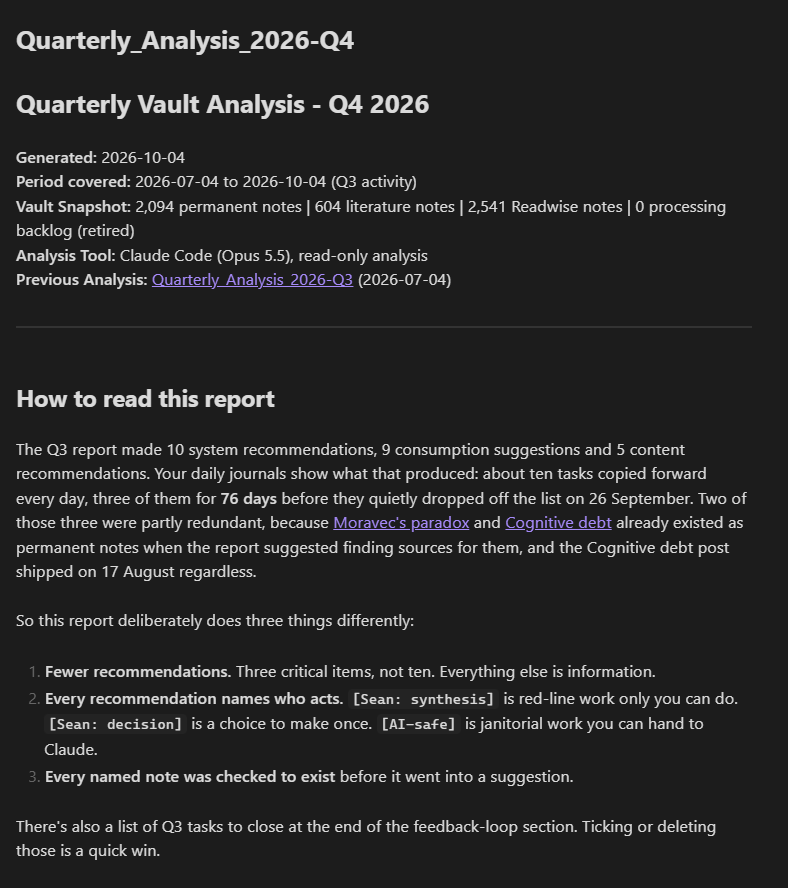
A section on how to read the report
The start of the report was the most interesting part for me. Claude had added this section in response to failures it had identified in the previous report, as well as my lack of capacity to act on its recommendations. This section also showed that Claude was taking my own red lines into consideration. You can find out more about my red lines in the introductory post Introduction to my AI Knowledge Framework level 0.
The error Claude had made was to advise me to search for sources on topics I already had notes for. To prevent this happening in future, Claude updated the skill to check that a note really doesn’t exist.
Every recommendation Claude makes in the report indicates who it thinks should act on it. This can be one of three values:
- Sean: synthesis: tasks specifically for me to carry out, due to my red lines
- Sean: decision: tasks where I have to make a decision about something
- AI-safe: tasks which can be handed over to AI, probably Claude
Quarter-on-quarter movement
The report includes a table highlighting the key differences between Q3 and Q4.
The biggest difference is the 1,693 Readwise notes (fleeting notes) that had been migrated across from my old queueing system to the current one. The work was carried out by Claude after I had decided to assume all those notes would go into my library.
During the last quarter, I had only created 9 literature notes, compared to 17 in the previous quarter. But I had created 30 permanent notes, compared to 41 in the previous quarter.
The maths seems to back up my thought that the literature notes in the last quarter must have been more dense. The 9 literature notes gave 30 permanent notes, about 3.3 each, while the previous quarter’s 17 gave 41, about 2.4 each.
| Metric | Q3 baseline (4 Jul) | Q4 snapshot (4 Oct) | Change |
|---|---|---|---|
| Permanent notes | 2,064 | 2,094 | +30 (Q2 was +41) |
| Slip-box notes touched (new + modified) | 136 in Q2 | ~120 | −16 |
| Literature notes | 595 | 604 | +9 (Q2 was +17) |
| Literature notes with no permanent-note section/links | 233 [~249] | 233 | Static |
| Processing backlog | 1,693 | 0 | Retired 2026-08-27 into 4_Readwise/ as library |
| Readwise notes | 580 | 2,541 | +1,693 migrated, ~271 new imports |
synthesise intent (all statuses) | 165 | 159 | −6 |
| Broken wikilink references | 1,497 | 1,434 | −63 |
| Isolated notes (0 in, 0 out) | 93 [56] | 87 | −6 |
| Vault Index coverage | 29 missing | 0 missing | Closed |
| Published pieces (quarter) | 17 | ~17 | Steady |
Days with writing: true | 80% (Q2) | 73% | −7 pts |
Days with workedOnNotes: true | 67% (Q2) | 55% | −12 pts |
| Daily journal consistency | 100% | 100% (92/92) | Maintained |
The bracketed figures are the ones the third-quarter report got wrong. The numbers outside the brackets are the correct totals, now that the issues have been resolved.
Some of the changes were compared to those highlighted in the report for the second quarter.
Emerging themes
The section on emerging themes was based on an analysis of new and updated permanent notes. Many of these notes were updated as I accessed and used them while writing blog posts, so they follow a lot of the same themes.
My main themes for the last quarter were:
- Reading, learning and meta-skills
- Collective intelligence and emergence
- Stoic virtues
- Technology history
Workflow observations
At the time of the review, half of the conversations I’d had with AI that I captured (55 of 107) were marked for synthesis, more than any other source. I think the question is: will I manage to synthesise them? To learn more about this part of my process, read Using Claude as a reading partner.
System health recommendations
Towards the bottom of the report is a section on the things Claude thinks I need to do to maintain my vault or get the best out of it.
The first is to decide how to protect time to synthesise ideas into my vault. Since I started keeping my PKM, there has been a battle between the time I spend writing my content and the time I spend working on my vault. Writing has always been the higher priority.
Take tonight: I’m writing this section of the post after a long day at work. I’ve prioritised it over my notes, and sometimes I run out of time, as my 11-month-old puppy Louis demands my attention. If I’m lucky tonight, I might get an hour.
Some days I also battle tiredness, as I have a full-time job.
It is an issue I do need to resolve, as synthesising ideas, facts and thoughts is the fuel that will keep me writing and learning. The only real solution is to equalise these two priorities. Maybe that’s something to consider for next year.
Secondly, and related to this, I must synthesise a specific book: John Searle’s The Construction of Social Reality. Once I’ve synthesised it, I’ll want to write about it, as it expands on the idea of intersubjective reality. The report suggests concentrating on 3 to 5 permanent notes from it, but I’m not going to do that. This is because I want to write my literature note in one go, starting from the beginning and ending when it’s finished. I think this is a better use of my limited resources.
Thirdly, it thinks I need to tighten up on the things I want to synthesise. It is a valid point, but it is easier said than done. As you will encounter content you find really intriguing and want to synthesis, but don’t currently have the time to do so. It is a real tension.
The key point of all this, and it’s even mentioned at the bottom of the report, is that all decisions are on me. Claude’s job is to highlight the patterns it sees and make recommendations based on them.
To be kept up to date with our most recent content, join our monthly newsletter.