
I was writing a post (I can’t now remember which one) when a half-remembered plot from the original series of Star Trek came to mind. I described the plot to Claude as I remembered it and, after a brief search, it suggested the episode was probably Spock’s Brain, in which a civilisation has become reliant on technology it no longer understands.
That query led to a conversation in which I suggested that due to AI we might be approaching a fork in the road. One way takes us down the path towards a new Dark Ages, while the other takes us towards a new cognitive renaissance.
Claude responded by suggesting a third path: a mixed bag in which both things happen. That idea intrigued me enough to capture it for a future blog post.
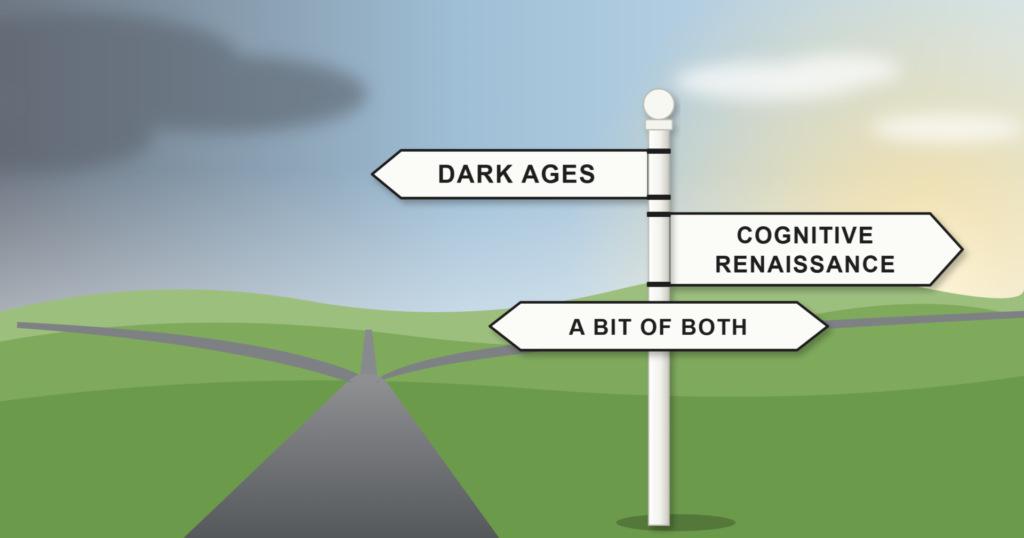
The two paths I put forward
The first path is a new Dark Ages. The Dark Ages, or the early Middle Ages as historians now prefer to call them, followed the fall of the Western Roman Empire. From what I remember of school, it was a period when Western Europe, including England where I live, lost a lot of classical knowledge, and that changed how people lived their lives.
This path would lead to another period of lost knowledge, as we let AI take over our thinking and lose much of our existing knowledge and cognitive abilities.
The second path is a cognitive renaissance, an idea taken from the Renaissance, the period in which Western Europe rediscovered classical knowledge. This path will happen if we learn how to use AI to improve our cognitive abilities and lift us to new levels of thinking.
The first is a path of darkness and human decline. The second is a brighter path towards a potential golden age for humanity.
A third path I hadn’t considered
Claude suggested a third path where both things happen, something I hadn’t even considered. In this world, some of us learn how to use AI to improve our cognitive abilities, and replace any thinking we offload to AI (hand over things for it to do) with other demanding cognitive tasks. That opens up the cognitive renaissance.
Others will replace what they offload with less strenuous tasks. Examples of this already exist, such as doom scrolling driven by persuasive technology.
In a way, we had a trial run of this with the Internet. In my post How the Internet Has Impacted Our Mental Capabilities, I compared the research on how the Internet affected us with my own experience of living through it. That experience has made me realise that, most of the time, it’s about replacing what we offload with the right thing.
This third path came out of a conversation between me and a generative AI, in this case Claude. As I’ve noted before, these conversations are like writing in a journal. Writing out my thoughts and giving them structure helps me think through my ideas and notice their weaknesses, even before the AI has had a chance to reply.
But the AI can also push back, as it did on this occasion by offering an outcome I hadn’t put forward. That opened up a perspective that might not have happened on its own. For me, that is a step along the second path. Though even this could have a cost. As I noted in my post What writing costs us, working with AI seems to average out our creativity, which could lead to less diverse thinking.
Uneven is how it usually goes
The Dark Ages weren’t felt evenly. The Eastern Roman Empire, Byzantium, survived the fall of the West, while the provinces of the Western Empire were deeply affected.
So history shows that a technology reversion, where knowledge is lost and technology goes backwards, doesn’t have to be spread evenly. But what about the technologies that spread knowledge?
Take the printing press, invented in Mainz in modern-day Germany around 1450. For the time, it spread quite quickly across Western Europe. It arrived in Venice, which would become the printing capital of Europe, in 1469, and in England by 1476. Yet it took until 1564 to reach Moscow.
The Web was invented at CERN by Tim Berners-Lee in 1989 and became freely available in 1993. That same year Mosaic, the first popular web browser, appeared and began spreading through universities. By 2024, 5.5 billion people, 68% of the world’s population, were online. That still leaves 32% without access (Internet use continues to grow, but universality remains elusive, especially in low-income regions).
It is this unevenness that forms the foundation of the exponential gap, which I explored in a series of posts starting with What Is the Exponential Age? Technology Explained.
What decides which path you take?
Here are the factors I think will influence which path you’re on.
- Experience amplifies AI. Those with experience are likely to get better answers out of AI than a novice who is still learning. Worse, using AI could stop the novice from ever becoming an expert. You can learn more about this paradox in my post The AI Cognitive Ability Paradox.
- Money opens up better tools, which amplify your ability to build more wealth, which buys better tools, so your advantage compounds over time. This is true of personal wealth, but also of the wealth of your society. How many of those 32% without Internet access live in Britain or the US, compared with the poorer nations on Earth?
- The feed is designed to fill the gap. When Claude helped me lay out this post, I thought it had gone a bit dark with this one, but I’m including it because it’s definitely a factor. As I admitted in How the Internet Has Impacted Our Mental Capabilities, I find it difficult at times to stop doom scrolling through YouTube videos.
As Epictetus put it in the Enchiridion: if our body was given to a stranger we would feel annoyed. Shouldn’t we feel the same way about our mind?
It isn’t only up to the individual
Some will argue that it’s up to the individual to decide which path they take. In AI and Information Overload: Why Our Minds Can’t Keep Up, I wrote that the economics of the exponential gap requires a social solution, while the cognitive gap requires us to act as individuals.
While writing, a good question came to mind: if money buys the tools, are the cognitive and economic gaps really separate? It’s one I hadn’t considered before.
After some thought, I think that the exponential gap has two potential causes: the first is economic, and the second one is due to us. This might be worth exploring in another post. Yet the exponential gap looks the same whatever the cause.
As with all things in life, I can only control the things I can control as an individual, and that includes campaigning for better equality throughout society.
The question is who we’re going to let control the path we’re on. Do we want to become a technocracy (government by technical experts), or even a meritocracy (government by those with the greatest abilities and skills), a term popularised by Michael Young in his book The Rise of the Meritocracy as a warning against that kind of government?
Which path am I on?
It’s a question I think I’ve been asking myself for years: how can I make sure I’m on the path towards cognitive growth? That’s why I’ve developed my red lines. I write the first draft of every blog post, and I write my own literature and permanent notes in my vault. AI can suggest links, but I decide them. These red lines are there to protect my thinking and my ability to learn.
But I also continue to explore how AI can help me develop my cognitive skills further, such as reviewing my vault or using Claude as my reading partner, as I recently wrote about in Using Claude as a reading partner.
This very post is proof of that. Claude helped me lay it out. I could have done it myself, but I wouldn’t have thought of some of the things I’ve now included, such as meritocracy. In fact, I had to check its accuracy with Gemini, as the concept came up in a conversation with Claude. But this is the key part: I write the post, and I decide what I keep and what I don’t. I know for a fact that I’ve already broken the word count Claude predicted.
This is something I find easier to do, as I can afford to pay for a Claude Pro subscription. This gives me access to Claude Code, which can access the vault directly, allowing it to both read and update my notes and blog posts.
Claude also does the SEO and writes the social media posts. All I do is check them, make the odd edit and paste in the link from WordPress. I don’t really care about learning these things, and Claude does a better job than I ever would, and it’s quicker.
Offloading this to Claude makes sense, as it allows me to concentrate on areas I do care about, such as working on the notes in my Zettelkasten. I can only do this as I have personal experience developed when I was younger.
I’m trying to battle the feed myself as I mentioned in my How the Internet Has Impacted Our Mental Capabilities post. I’m currently trying to manage my desire to scroll through videos on YouTube and before that Twitter.
For once, I think age has worked in my favour, as I had to learn things before the Internet, let alone AI, and those techniques help. I also think having a Zettelkasten and those red lines help me to decide where and when I use AI.
I also think I was fortunate to have an interest in technology and computing, sparked by the home computer boom, as I found it exciting in my youth. And AI is inspiring the same interest as my home computer did back in the 1980s.
That doesn’t mean I think those growing up in later generations will be cut off from my path. As with any skill, you can learn to keep the effort and struggle that help the things you want to learn stick, though it might be more of a challenge.
If you can read this post, you can probably access the free models from OpenAI, Anthropic and Google. They won’t be the frontier models, but they will still give a good indication of what AI can do.
A story waiting to be written
During the conversation with Claude, I commented that this idea could make a good plot for a work of fiction. Concepts that became common, such as meritocracy, cyberspace, or even robot, came to public notice through works of fiction.
I haven’t really thought about the plot, but one idea is to follow two people through their lives and explore how life on each side of the fork affects them. They might be neighbours or, more likely, twins.
Which path are we on?
Maybe there isn’t just one fork. Maybe we’ll all reach it at different times, or keep reaching it as the capabilities of the models change and the exponential gap changes. That’s a question we could explore in a future post.
The question for you now is: which path are you currently on, and is it the right one?
Enjoy our content? Why don’t you join our monthly newsletter to be kept up to date with our most recent content.
Further reading
- Wikipedia entry on the dark ages: Wikipedia entry on the Dark Ages, which I used to fact-check Claude
- Internet use continues to grow, but universality remains elusive, especially in low-income regions: The source for my statistics on the number of Internet users
- How the Internet Has Impacted Our Mental Capabilities: My post exploring the impact of the Internet on our cognitive ability, as someone who has lived through it
- What Is the Exponential Age? Technology Explained: The introductory post in my series on the Exponential Age, a concept that might give strength to the third path
- The AI Cognitive Ability Paradox: A post exploring the AI cognitive paradox: to get the most out of AI you need good cognitive abilities, the very skills that using AI can harm
- Using Claude as a reading partner: While the query that led to this post wasn’t directly about reading, the process was similar to how I use Claude as a reading partner